Three creators discuss who really owns content, the exhausting race against algorithms, and why making great work is harder than it looks.
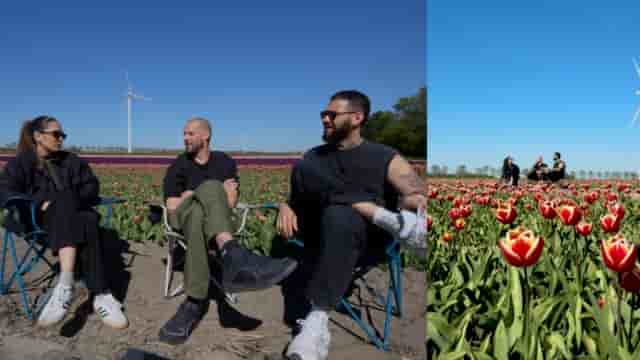
Frank, Diego, and Fiona sat down in a Dutch tulip field to talk about Subwave, a publishing platform where you can upload video or podcast audio and transform it into written content, then send it as a newsletter to subscribers. All in one place. But the conversation quickly went deeper than product features.
The question of who owns your content sounds simple until you actually think about it. "The creator," Frank said immediately. "You came up with the idea. That's how it should be." But Fiona pushed back on the idealism. Every time she posts something on Instagram, it stops belonging only to her. It belongs to her plus something else. Something undefined.
Frank drew a comparison to cinema. If a director makes a feature film that plays in theaters, does the cinema own that movie, or does the director? The platform is just your outlet. The creator should still own it. But then there's money involved, and the platform is helping you reach an audience, so maybe both should benefit. "But that's the key," Diego pointed out. "You're saying should. I don't think that's the reality."
"Every time I post something on Instagram, it stops belonging to me. It belongs to me plus something else."
The conversation turned practical. What happens if Instagram or TikTok just stops working? Fiona realized she doesn't have backups for so many videos she's posted. She just trusted they'd be there. Frank mentioned data requests, that feature where you can retrieve all your content from platforms like Instagram, iCloud, or Google in a big package. You can actually download everything. But how many people do that? And if you don't retrieve it before it's lost, then it's not yours anymore.
The distinction matters. Technically, you own your content. But if you don't have it backed up and the platform disappears, ownership becomes a meaningless concept.
"I hate this word," Diego said about the algorithm. "Because of what it represents." The reactions were mixed. Fiona admitted she wants to see content she's interested in on her explore page, but it also feels very random. Sometimes her feed is filled with things she's never looked at. The platforms are trying to read you, predict you, and it's unsettling.
The ads are getting worse too. Instagram is testing ads in Stories that you can't skip. The algorithm tracks you to serve you content you might like, but is that better than having content you don't like? At least it's tailored. But it's still weird to be constantly tracked.
For creators, the algorithm feels like a race you're never going to win.
Diego broke it down into two perspectives: as a consumer and as a content creator. As a consumer, sometimes the algorithm feels like it's hearing you, giving you what you want. But as a creator, it's exhausting. It feels like you're running a race where every time you think you're at the finish line, a new algorithm comes out and pushes the goal further away. You're not making a video because that's what you want to do. You're making it because you feel like that's what you have to do to beat the race you didn't even want to enter.
"It's unhealthy," Frank agreed. And for kids growing up with this, it's even worse. They're all trying to stand out, trying to go over the top, and the stakes keep rising. Diego admitted he sometimes forgets why he's creating content because all he's thinking about is beating the algorithm, getting picked up by the algorithm. There's a cloud of cool ideas he could explore, but he doesn't listen to them because he's only focusing on this thing he hates.
Fiona offered a reality check: the algorithm is random anyway. You never know what kind of content is going to do well. Even the algorithm doesn't know. It's just pushing what's already working and getting traction. So why not be creative? Don't let the algorithm stop you.
When asked if they'd want to turn every voice note into content, Fiona laughed. "I wouldn't want all of my voice messages to turn into articles. It would be a very dark piece of reading." But she liked the concept. If she wanted to upload an article without a video attached, she'd rather record a voiceover than write it down. That's just easier for her.
Diego saw it differently. He's not great at writing either, but that's where AI becomes useful. It's still his voice, just arranged better. Frank has been using the feature a lot for Detail and Subwave explainer videos. When he reads back the AI-generated article, he's sometimes surprised by the summary. It's more enjoyable to read than what he would have written himself.
AI puts your thoughts into a better format, making them more enjoyable to read.
Frank made the case that AI helps everyone who's a creator. It assists you in putting out content quickly without losing your voice. For people who aren't journalists or experienced writers, AI can take a long answer and make a shorter, more readable version. That's genuinely helpful.
So who should use a platform like Subwave? Frank's answer: everybody that has a story to tell. The local accountant explaining tax declarations. A baker sharing recipes. A chef building a cookbook. A DIY enthusiast showing how to fix things. You don't need a professional camera or a studio or a big following to be a creator. Everybody with an opinion or a story can be one.
Diego gave a specific example. Right now he's uploading content about how to get creative when you're not feeling your best. Making videos is hard. People say it's easy, but sometimes you just don't want to. And maybe he's overthinking it, but he wants it to look good and sound good. That takes effort.
The group debated whether people overcomplicate content creation. Frank pointed out that the tools are cheap and available. A phone is more than enough to record something great. But Diego and Fiona pushed back. Everyone can film content, but not everyone can film good content. Visually, some videos aren't interesting, but sometimes the story matters more than what you see.
Fiona brought up the aesthetic factor. For short-form content on Instagram and TikTok, a lot of it is aesthetic. When she films for Detail, she asks herself: would Apple want this? If they were having a presentation, would they want this video on the big screen? That's the standard she's aiming for because Detail is professional and aesthetically pleasing, and the short-form content should reflect that.
Great content isn't difficult to make, but making something you're proud of takes a long time.
Not everyone has that eye. Some people don't see the difference between filming in a random spot versus filming in a tulip field. It's not laziness. They just don't have it in them, the same way Diego doesn't have math skills.
Frank brought up Mr. Beast. His content is over the top, and it keeps getting more extreme. It's not Frank's thing, but it's visually interesting and people talk about it. On the other end, there's Diary of a CEO. Simple setup, solid aesthetic, entertaining podcasts. A lot of that is the editing style. Abby tends to watch those podcasts rather than just listen to them because she loves the way they're edited.
The conversation took a turn when Frank admitted he consumes content at 1.5 or 1.8 speed. Diego was against it. If someone made the effort to create content, you should watch it the way they intended. He listens to full albums from start to finish, not skipping songs, because that's what the artist intended. If a creator wanted the video faster, they could speed it up themselves.
Frank's argument: if he's on a flight and has one hour, he can fit in a 90-minute podcast by speeding it up. It's not music, it's just vocal content. And he feels more productive that way. He can consume more.
Fiona called it insatiable. Frank agreed. He'll eat a chocolate bar really quick too. No sharing.
Fiona doesn't speed up content because she already has a Gen Z brain, and frying it even more isn't an option. Her boyfriend does it often, and she's always against it. Can you even follow? Will you remember what the person said? But her friends' voice messages? Those she listens to at 2x speed. "It's just 10 minutes of rambling," she explained. You want to get to the point.
Frank pounced: exactly. That's the point. You want to speed it up a little. Diego countered that the friend doesn't spend money on production, so it's not the same. Fair point. If there's product placement in a video, watching at 1.5x speed means you see 1.5 times the product placement in the same amount of time. Everybody wins.
Fiona felt like she was in the middle of Frank and Diego, brain-wise. Frank had a normal childhood without mobile technology until around 14. They're the last generation that grew up without phones. You had to wait for an episode to come out. If you missed it, you missed it. Now Abby has so many things she can watch at any moment, and that's why she's not watching them. They're too available.
She doesn't have older siblings to guide her, just a sister two and a half years older. Diego is the more advanced one in his family. And Frank's kid sometimes sits on the couch for hours, plugged into the wall charger because the battery died. When Fiona’s phone dies, she feels relieved. She charges it and enjoys the time away.
She met a friend her age in Berlin who blew her mind. After being out all day, Abby was scrolling on her phone. The friend was just lying in bed. After 30 minutes, she said, "Oh, it's at 70%. I have to wait longer." Fiona was confused. The friend explained: whenever her phone dies, she waits for it to charge to 100%, then grabs it. Fiona thought that was amazing. Imagine having that freedom, that patience, to just leave your phone even though you could grab it and scroll. "Patience is not an attribute that I have," Diego said. Same for Fiona.
As they wrapped, the group agreed to do this more often. Every two weeks, weather permitting. They're Dutch, so that means as long as it's not raining. Next episode might be the beach, the dunes, or even a boat. If viewers have questions, hot takes, or suggestions, they're open to it. And they're launching a special Subwave channel for these longer podcast episodes.
Frank wondered how many tulips they were seeing. Fiona guessed 5,000. It was actually a perfect location, exactly what Diego had envisioned when they talked about going to the tulip fields. The weather cooperated. The setup wasn't hard. They manifested it.
As they packed up, someone asked if they needed an exit. Diego sat back. "See you on the next one." But Frank had one more serious question: should they really do this more often? The answer was yes. They just started. And the tools to create are cheap and available. The question is what you want to do with them.
For now, they're doing this. Two times a month. In random beautiful spots. Talking about algorithms, ownership, creativity, and whether or not to speed up podcasts. The kind of conversation that doesn't need to beat the algorithm because it's just real.