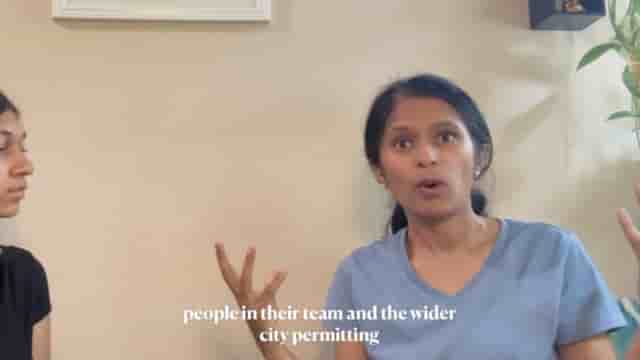
Sneha Sriwastava walks through what solar project development actually involves, from permitting battles to cancelled projects, and why communication matters more than engineering.
Most people have never heard the job title "solar project developer." Fewer still could explain what one does on a Tuesday afternoon. Sneha Sriwastava can, and her version of the job sounds nothing like what you'd find on a career day poster.
Sneha takes a solar project from the moment it lands on her desk to the day the panels go live on the ground. That means working with customers, engineering teams, city permitting offices, utilities, banks, and financial advisors, sometimes all in the same week. The design work is real, but it is only one layer of the role. The rest is coordination, persuasion, and persistence across groups of people who have very different priorities and timelines.
It's almost like making a pie. You get the ingredients from various places, but you don't make the ingredients.
The misconception she hears most often is that her job involves manufacturing solar panels. It does not. The panels already exist. Her work is assembling the right components, navigating every approval and financial incentive the project requires, and getting it all to line up at the right moment. "Sometimes the recipe is fixed," she says, "but the way things come along is always going to be different each time you bake it."
Sneha came from a civil engineering background with a strong interest in environmental sustainability. When solar energy appeared as an option, she recognized it as a path that let her care about the environment in a concrete, visible way. Each project she completes puts power from the sun into a building. She can see what she built.
What she did not expect was how much of the job runs on communication rather than engineering. She works with project managers, customers, utility representatives, permitting departments, and her own team members. Getting a project installed requires each of those groups to understand what she needs from them and why.
"One very important skill is how to break a concept down and explain it to somebody so that they get buy-in and they can help assist along the way."
Technical knowledge matters, but it reaches a ceiling. At some point, Sneha says, the job stops being about what you know and starts being about whether you can get the idea across to the person sitting across from you.
Sneha is direct about the days she dreads. Permitting departments operate on their own schedule and often have little investment in a project's timeline. Financial incentives run out. Banks and accountants have to be kept engaged through long approval processes. On those days, she says, persistence is the only tool available, and sometimes even persistence is not enough.
There are days when I kind of dread having to keep on pursuing the same topic.
One of her projects stalled despite everything going right. She had the utility on board, the permitting officer aligned, the client committed. The timelines simply did not match, and the project was cancelled. She describes it as feeling like a failure, then immediately reframes it: the lessons from that project get applied to every new one that follows. The knowledge earned in a cancelled project does not disappear.
The work-life balance question gets a similarly honest answer. The solar industry has a natural rhythm: when the sun goes down, most of the work stops. That gives her time back most evenings. But there are deadline periods when the pressure builds and she has to lean on her family and colleagues to carry some of the load. She keeps a holistic view of her schedule so that a hard stretch does not feel permanent.
Sneha was in high school before solar project development existed as a job title. She chose civil engineering because it offered design independence and a wide range of directions, not because she had a destination in mind. Along the way, people suggested she might be better suited to non-science work or pushed her toward electrical engineering. She followed her own read of what she wanted and stayed open to where the field could lead.
The path she actually took went: civil engineering, then project engineering in sustainability, then solar. Each step was an adjustment, not a restart.
"There are so many ways to navigate your career. Oftentimes the fact that you know you don't want to do something helps you to explore more options in between."
That framing matters for anyone who feels locked in by a decision made too early. Knowing what you do not want is genuinely useful information. It narrows the space and points you toward the branches you have not tried yet.
For a teenager curious about the field, Sneha's advice is to figure out which part of solar actually interests them before assuming there is only one way in. The industry has roles across the entire chain: salespeople who bring in new projects, developers like Sneha who take those projects through engineering and approvals, and installation crews who physically put the systems in place. Someone who wants to be on a rooftop wiring panels has a very different entry point than someone who wants to sit in a utility coordination meeting.
The one thing she says distinguishes the people who do well, beyond having the right credentials, is a genuine drive to keep learning. Solar technology shifts constantly. Policy and financial incentives change with the political climate. A person willing to get their hands dirty, go to the field, and update their knowledge as the industry moves will outperform someone who stopped learning once they had the qualification in hand.
The career she built did not exist when she was the age of the students she is speaking to. The careers available to those students in ten years may not exist yet either. What carries across all of them is the same: find what you care about, stay curious about where it can take you, and be honest about what you are not willing to do.