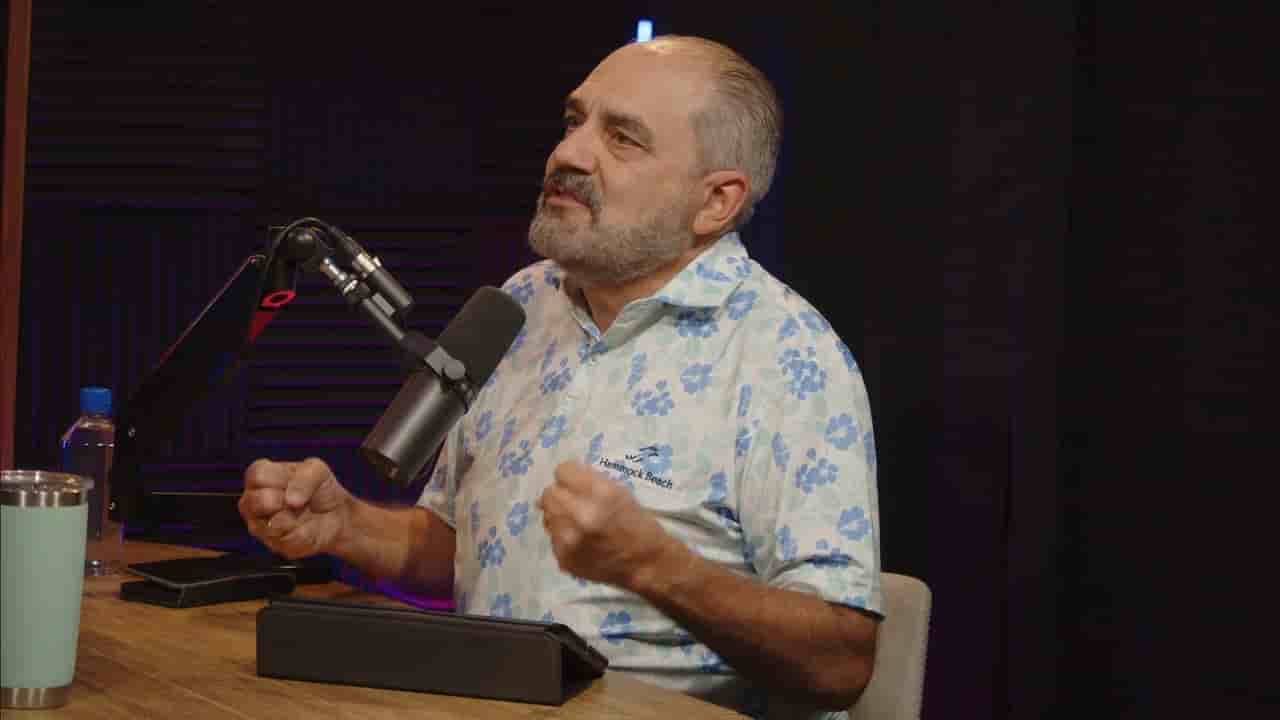
Todd and Katie of the Last Days Podcast argue that adversity is a real opponent, and that beating it takes consistent daily discipline of spirit, soul and body.
A coach doesn't walk over in the middle of a game and tell you to think happy thoughts. He tells you to put your game face on. Todd and Katie, who host the Last Days Podcast from Johnson City, Tennessee, build their whole approach to adversity on that picture: a believer is in an actual contest against an actual opponent, and cheerful thinking alone will get your tail whipped.
Their claim is that people lose these fights for two reasons. They misidentify the opponent, and they treat the response as something that happens when they feel spiritual instead of something they do every day.
The starting point is Ephesians: we wrestle not against flesh and blood. Todd points out that the verse doesn't say we don't wrestle at all. It says the fight isn't against people. That means there is a fight, and it isn't only in your head. Some believers deny anything is coming against them, and others just live on what Katie calls the struggle bus. Both are wrong. Constant, vague struggle is not anyone's lot in life, and neither is pretending nothing is happening.
Todd is blunt about the stakes. He is communicating with people right now who are in a life-and-death battle. Jesus said the enemy comes to steal, kill and destroy, and Todd notes that this is no cat burglar going after something small. The target is bigger than you: your marriage, your ministry, your family, everything around you.
They also reject the idea that attack means you did something wrong. When someone asks why they were hit, Todd's answer is that they breathed. The enemy can't touch God, so he goes after what is close to God's heart.
If he wasn't actually an opponent, the Bible wouldn't call him an adversary.
Todd and Katie return again and again to fear as the enemy's first tool, because a mind game is cheaper than a brawl. Todd compares it to an NCAA game he watched: his Gators beat the number four team soundly, then came into the next week unprepared for Missouri, who exposed them on offense and defense. His point is that an opponent who failed last time will try something new, and that you can't prepare once the attack has started. You have to be ready beforehand.
Todd says he heard from a man that very morning who admitted he was dealing with fear. Todd's answer was that fear has to be fed, either by past experience or by what we've been told. We are not naturally fearful. We are given dominion, and 1 John 4:4 says the one in us is greater than the one in the world. Fear arrives from outside, and it works by tilting your head into thinking this is a situation you've never handled.
Katie adds that the enemy often mixes a little truth into a lie so that you grab hold of it, and that fear sometimes shows up disguised as limited thinking. Her answer is to recognize it quickly, take authority over it, and start declaring the Word again. Todd's own version comes from tennis. His older brother talked trash across the court, and a semi-pro coach told him to counter with his own words. You don't talk trash to the devil. You talk Word to the devil, the way David answered Goliath.
Katie lays out the team-sport framework she uses when teaching on faith. A team needs both a defense and an offense to win. Your defense is the authority you stand on. James 4:7 says submit to God, resist the devil, and he will flee, and you can't do the second half without the first. Jesus took back the authority that had passed to the devil and gave it to the born-again believer. Neither Jesus nor the Holy Spirit exercises it on your behalf, which is why she thinks many people fail to walk in dominion.
Offense is declaration. A team with only a defense can stop its opponent from scoring but can't win. What you speak of the Word, you believe at a higher level, and she holds that it helps bring the thing to pass. She adds that we believe our own voice most, and that declaring impossibilities leaves your mind unable to see anything else. Paired with godly vision rather than natural vision, which only sees limitations, things move faster.
Neither half works alone. Submitting to God while refusing to resist the devil, or resisting while refusing to submit, gets you nowhere.
"If you don't realize what belongs to you and what he's trying to steal from you, you're just going to lay down."
All of this, they say, comes down to doing it every day. Katie recalls Todd's message from a few weeks back on the secret sauce being consistency. Back when Todd was dean of a Bible school in Tampa, they watched students with remarkable gifts, some who preached better than people decades into ministry, fail to make it through the first year. The gift was there, and the daily discipline wasn't.
The advice sounds simple: resist the devil, take authority over him. But the question Todd keeps asking is whether you actually do it. Doing it only when you feel strong, or only when people are watching, is not enough. You have to stir yourself up.
Glory isn't second place.
The second half of the conversation turns practical, and the hosts expect it to lose some listeners. They say so repeatedly, asking people not to turn them off. Their argument is that you can't call yourself strong because your spirit is strong. You are a spirit, you have a soul, and you live in a body, and each needs strength.
Spirit. Being born again is paramount, and they insist every believer needs to be filled with the Holy Ghost to overcome. You build yourself up by praying in the Spirit, and the Spirit has to be in you, not somewhere out there.
Body. A strong spirit does little good if your body keeps you stuck at home. Todd says people sometimes blame the devil for problems they brought on themselves by becoming sedentary or by eating until they broke down their own immune system. In his words, the devil didn't stuff the cheesecake in your mouth, and he can sit back and cheer you on because he doesn't have to get involved.
Soul and mind. They warn against alcohol, gummies and weed, and against the idea that something being legal makes it wise. They also describe a stay-at-home, screens-all-day, avoid-people pattern that weakens the mind, and Todd uses Proverbs 24:10 for it: if you faint in the day of adversity, your strength is small. After a good deal of grumbling about emotional support animals at the airport, the conclusion Todd lands on is that a Pekingese won't help you when the devil attacks. You need a strong mind.
Katie ties it back to discipline. An undisciplined mind and lifestyle will not produce a spiritual giant, and people who know all the preaching but apply nothing to their own lives end up flaky.
Todd closes with his own case. He has never had a left hip socket, and he was told repeatedly that he couldn't do certain things. In sports he asked what he had to do to compensate so he could compete, and he refused a separate class or special allowances. Nothing in the rules changes, he says. What changes is inside your mind. He applies the same thinking to mental struggles: he allows that some help may be useful short term, but he says God can heal the mind as he heals the body, and the Word has to be spoken to both daily.
Katie adds that the mindset you build in the natural carries into the spiritual, including the discipline to keep going when no one is watching and you're tired. Her answer is that Christ is working in you and through you, and she means it as a daily practice rather than a feeling: take authority over your thoughts, submit to God, resist the enemy, look after your body, guard your mind, and do it again tomorrow.