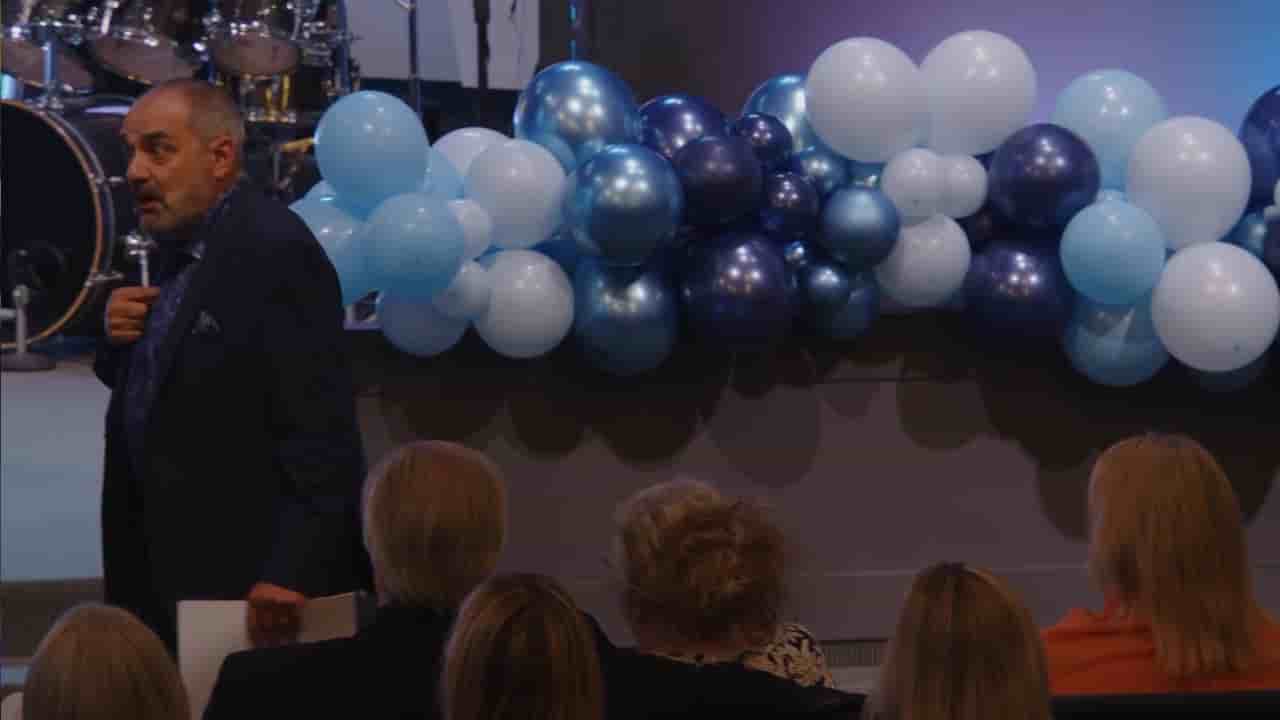
A church turns eight with a clear conviction: forward motion is the only option, and comfort is not the goal.
Forgetting what's behind is harder than it sounds. It's not just the failures you have to release — the bad reports, the betrayals, the seasons you'd rather not revisit. It's also the successes. The moments you want to hold up and say, this is me, this is what I've done. Paul had both in abundance, and he let go of all of it. That's the kind of forward motion that actually means something.
Philippians 3 is the best single-chapter summary of Paul's entire life and ministry. He survived shipwrecks, beatings, and imprisonment. He planted churches across Europe and Asia Minor. He wrote two-thirds of the New Testament. And at the end of it all, his posture was still the same: I haven't arrived. I'm pressing forward. That example doesn't get old.
I press toward the goal to the prize of the high calling of God in Christ Jesus.
There is a version of faith that marks time. It shows up on Sundays, it gives an offering, it waits to see what happens. That's not what we're building here. This church has never been about having a small mindset — pioneering something and then just letting it sit there. The vision from the beginning has been a hub, a launching point, with more going out of it than most people can currently see.
Habakkuk had something to say about that. Write the vision on clay tablets. It's for an appointed time. Even if it seems delayed, it's coming. Don't count it out just because 18 months passed and things haven't arrived yet. Some of what God wants to do through a place like this will continue long after the people who started it are gone. That's not a small thing to sit with.
The things that will take place from this church will continue on, and even greater, after I'm gone.
The point isn't longevity for its own sake. It's that the kingdom of God doesn't retire. Neither should the people building it.
Paul is described in the New Testament as someone who caused things to happen everywhere he went. That's the definition of a catalyst: you don't just occupy space, you change the environment around you. He could have pulled back after the first near-death experience, let alone the fifth. He had plenty of religious cover to play it safe and stay within known boundaries. He didn't, because he had a vision from God to carry the gospel to the entire known Gentile world, no matter what it cost him.
That phrase deserves to land: no matter what it costs me. Not "as long as it's convenient." Not "as long as people understand." No matter what.
"There isn't a week of my life that goes by without me reading much of the life of Paul and things that he wrote."
What does it look like when that kind of vision gets applied to ordinary life? Sometimes it looks like a trip to a craft store to pick up balloons. A young man behind the counter was shaking so badly he couldn't tie the strings. An hour of working alongside him, tying balloons, making small talk — and then asking: will you let God touch you? The balloons were never the point. They never are.
In India, there were billboards up across the city ahead of a crusade. The images showed two faces, and the headline read: Let Jesus Heal You. No names underneath. Just faces and an invitation.
A Hindu high priest lived 500 kilometers away. He and his wife had a granddaughter, paralyzed from the neck down since birth. They begged for money, fought through poverty, traveled the distance to Kanpur. On the final morning of the crusade, they walked into a church mid-service carrying this girl, maybe not even 10 years old. They had seen the billboard. They thought the face on it was Jesus.
The grandfather walked straight to the front of the room and threw the girl into my arms. She was not happy about it. And then he and his wife dropped to their knees and began kissing my feet.
They had heard. Like the woman with the issue of blood, they had heard. And as soon as she hit my arms, immediately her arms and legs began to flail.
It wasn't faith on my end. I had no idea what was happening. But God recognizes faith wherever he finds it. That little girl was healed completely, instantly, and the family that came in as Hindu walked out as children of God, filled with the Holy Spirit, having renounced everything they'd believed before. Healing always answers the question.
The power of God isn't supposed to stay inside a building. It's supposed to ooze out of the people who gather in one. That's an intentional word — ooze. Not broadcast, not advertise, not perform. Ooze. When people are around you at work, at the store, in the break room, they should sense something different. Not because you told them you're a Christian, but because you can't contain what's inside you.
That's not a license for spiritual chaos. It's the opposite. Do your job. If you're hired to do sales, do sales. If you're hired to clean, clean. Excellence is the testimony. The fruit of the Spirit visible in your character, the quality of your work, the way you treat people — that's what earns the right to a conversation. And when the conversation opens, it opens naturally, because you weren't forcing it.
They shouldn't know you're a Christian because you carry a ten-pound Bible. The power of God should radiate from you.
The goal isn't a church that produces great Sunday services. The goal is people whose everyday lives are so saturated with the presence of God that revival breaks out wherever they go.
Active vision, in the simplest terms, is what happens when you open your eyes and actually look at what's around you — taking in what's there, understanding how you fit, moving accordingly. The alternative is a life where every day is the same as the last, and you call that faithfulness.
Caleb was 85 years old and still asking for the hardest assignment. He and Joshua were the only two who came back from scouting Canaan with a good report. The other ten said there were giants. Joshua said the giants are bread for us. That's not bravado — it's the recognition that opposition is what sharpens you. The giants make you better.
Nehemiah rebuilt the walls of Jerusalem in 52 days, surrounded by the entire city, while holding a trowel in one hand and a spear in the other. The enemies were real. The death threats were real. The opposition came from every direction. None of it stopped the work because he had something inside him that he couldn't set down.
Joseph refused to get bitter. He was sold into slavery by his own brothers, betrayed by leaders, imprisoned — and he kept doing the right thing in every room he landed in until he became the prime minister of Egypt. He didn't use trauma as a ceiling. He kept taking ground.
Mary didn't settle for being a polite host. She broke an alabaster jar, poured out a year's wages, and got publicly condemned for it by the people closest to Jesus. She probably never expected the story to leave that room. She did it because she couldn't hold back. And Jesus said what she did would be told for generations.
The vision described in Proverbs 29 — where there is no vision, the people perish — carries more weight in the original Hebrew than the English suggests. The word translated "perish" is closer to "run wild," to "cast off restraint." Vision isn't just inspiring; it's structural. It gives your life boundaries that actually set you free.
This is what the three E's of this church are built on: people must encounter God, leaders must be equipped, and the kingdom must expand. None of those three things happen through passive attendance. They require skin in the game.
Being generous with money is important. It's also not a substitute for showing up and serving. The church doesn't run on offerings alone. It runs on people who insert themselves into whatever needs doing and figure it out as they go. Not because they know how. Because they know why.
Offerings don't excuse activity. You need to be active.
Missions teams are going out. A "Fire in the Mountains" revival week is scheduled for the first full week of 2026. International Zoom calls go out every other week to leaders around the world. There are evangelists based out of this church reaching places the congregation will never go in person — and their fruit counts for everyone who prayed for them, gave for them, supported them from home.
God can change you and use you at the same time. He doesn't need you to be finished before he puts you to work. He just needs a yes.