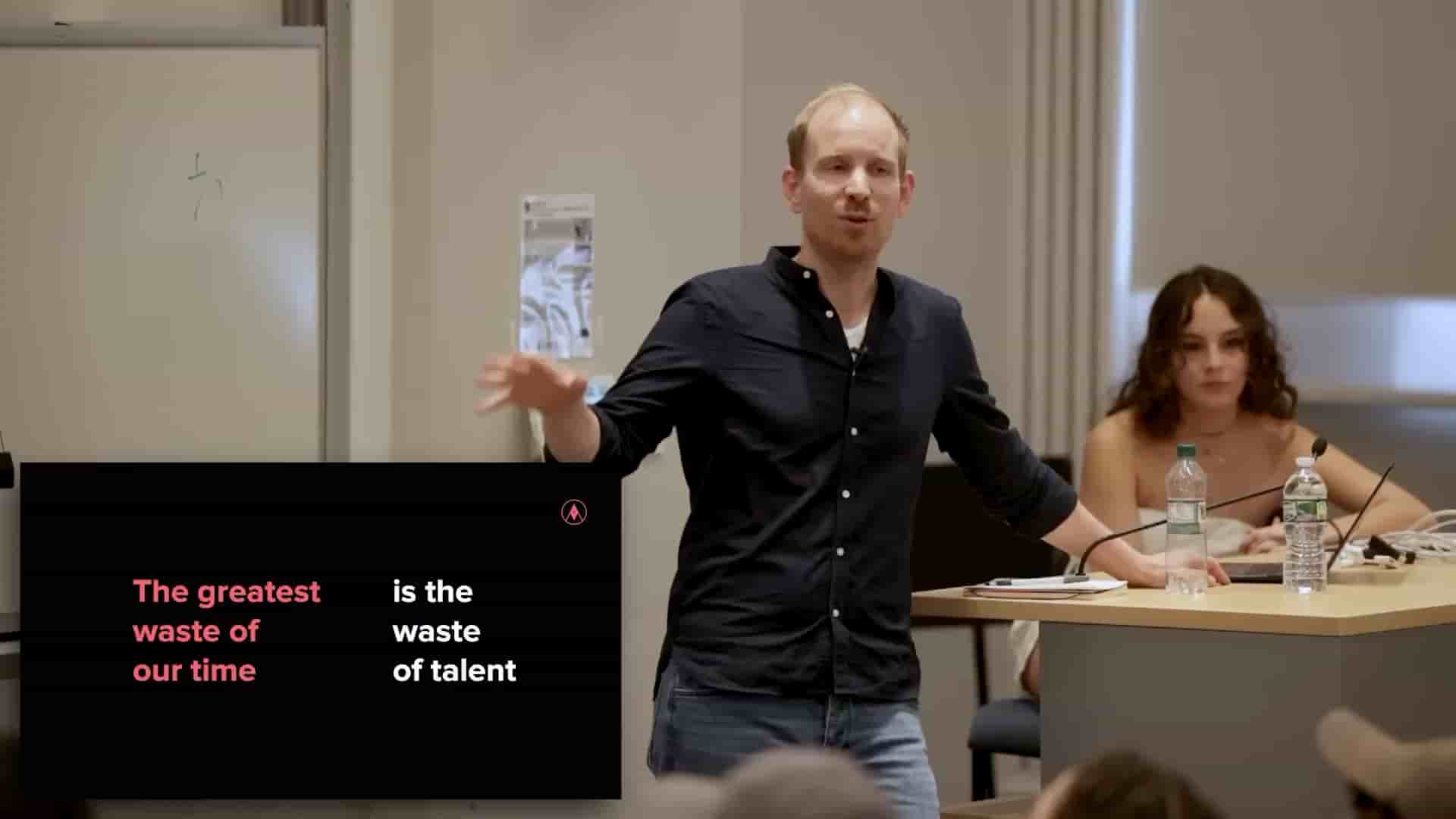
Rutger Bregman argues that 40% of Harvard graduates flowing into consulting and finance is a civilizational misallocation of talent, and he's building a school to fix it.
About 40 percent of Harvard graduates end up in consulting, finance, or corporate law. That number has haunted Rutger Bregman long enough that he wrote a book about it, flew to Cambridge to confront the students directly, and then built an organization to pull some of them out. His argument, laid out in Moral Ambition, is straightforward and a little uncomfortable: we are living through a catastrophic misallocation of talent, and the people most responsible for fixing it are the ones currently most seduced by the wrong incentives.
Bregman opens with arithmetic. A career lasts roughly 2,000 work weeks, 80,000 hours, 10,000 working days. That finite budget is, he argues, one of the most important moral questions any person will ever face. What you do with it is not just a lifestyle choice. It is a statement about what you think matters.
The cigarette is the deadliest object ever invented in the history of humanity.
The phenomenon Bregman describes as the "Bermuda Triangle of Talent" is not new, but its scale at elite institutions has grown. In the 1970s, the pull of consulting and finance at Harvard was modest. Today it absorbs nearly half the graduating class. At the same time, data from the American Freshman Survey shows that the share of students who list "developing a meaningful philosophy of life" as a primary goal has collapsed from roughly 90 percent in the 1960s to a minority position today, while "making a lot of money" has climbed to match and surpass it.
What makes this more than a sociological curiosity is a parallel finding: about a quarter of people in the modern workforce believe their own job is socially meaningless. The academic term, coined by the late anthropologist David Graeber, is "bullshit jobs." Crucially, the people most likely to hold these jobs are not the ones with the thinnest resumes. Teachers, nurses, and care workers consistently report high social meaning. The overrepresentation of bullshit jobs shows up among people with fancy LinkedIn profiles, consulting experience, and, yes, Ivy League degrees.
We live in a society that has made the wrong things high status, and that's got to change.
Bregman spent roughly a decade in what he calls the "awareness industry," writing op-eds, books, and articles, hoping that someone else would do the actual work. His Davos moment, going viral for telling a room of billionaires they don't pay their fair share, crystallized the problem for him. It felt good. It changed almost nothing.
The emotion he developed over that period he calls "moral envy." He was researching the great abolitionists, reading Thomas Clarkson's memoirs, and found himself wishing he were actually in the arena rather than writing about people who had been. That frustration eventually became a diagnosis: the left, he argues, has its own version of the right-wing excuse. The right tells people to pull themselves up by their bootstraps and ignores structural injustice. The left talks endlessly about overthrowing systems while declining to examine what they themselves are doing with their own careers and talents. Both moves let the individual off the hook.
His conclusion: awareness is vastly overrated. What replaces it is moral ambition, which he defines as the combination of an entrepreneur's drive, an activist's idealism, a scientist's rigor, and a monk's humility.
Bregman's favorite historical case study is Thomas Clarkson, a Cambridge student in 1785 who entered an essay contest on a whim. The assigned question was, roughly, whether it is acceptable to own and sell other human beings. Clarkson had barely thought about slavery before. He researched it to win the prize, won it, and then had a crisis on the road back to London, near a village called Wade's Mill, where he realized that if everything he had written was true, someone ought to do something about it.
He spent more than 60 years fighting the slave trade. In the first seven years alone, he traveled 35,000 miles across Britain spreading abolitionist materials. Then he had a complete nervous breakdown. He couldn't climb stairs. He broke into sweats whenever he tried to speak. He burned out at 33.
I mean, you'll probably get a burnout as well. But it would be nice to get a burnout while you work on stuff that's actually important.
What Bregman finds equally striking is who built the British abolitionist movement around Clarkson. Of the 12 founders of the Society for the Abolition of the Slave Trade, 10 were entrepreneurs, people who had built and scaled companies, accumulated wealth, and then redirected their talent and resources toward the fight. Britain's abolition movement succeeded without a civil war, unlike the American one, and it was led not by intellectuals or writers but by people who knew how to build things.
Bregman distills his framework into three components.
1. Redefine success. He borrows a line attributed to the writer Ellen Rain: people spend their whole lives climbing the ladder of success only to find, at the top, that the ladder is leaning against the wrong wall. The cultural project he sees as most urgent is making doing good fashionable again. His observation from watching friends at McKinsey is revealing: telling them they're greedy bounces off completely. Telling them they're boring, that they're wasting talent that could have done something remarkable, lands differently. Status is the currency, and right now it's being spent on the wrong things.
2. Focus on maximum impact. Bregman is impatient with the "small is beautiful" objection. If helping one person is good and helping two people is better, then scale is a moral variable, not a sign of hubris. Winning, he argues, is a moral duty. The noble loser who stood on the right side of history but lost every election is not a model worth emulating.
3. Follow the Gandalf model. Gandalf did not ask Frodo what his passion was. He told him to throw the ring into the mountain because the world needed that done. Bregman's version of this is to stop gazing inward at what you feel called to do, and instead ask the world what it needs from you. The practical tool he offers is what he calls the SSS framework: find problems that are sizable, solvable, and sorely neglected. Climate change is large and solvable, but it is no longer neglected. Food systems and factory farming, by contrast, account for roughly 20 percent of emissions and attract a fraction of the attention and funding. Alternative proteins have received about $1.5 billion in government investment, a rounding error compared to clean energy or electric vehicles.
One of the most striking pieces of research Bregman cites concerns not careers but the Dutch resistance during World War II. The Netherlands lost a higher percentage of its Jewish population to the Nazi genocide than almost any other occupied country, and relatively few people chose to resist. Researchers spent decades trying to identify what kind of person joined the resistance. Was there an altruistic personality type?
The answer, documented across hundreds of interviews, is that there was not. Resistance heroes came from every point on the political spectrum, every income level, every educational background. The statistical evidence of a distinct personality type was essentially nonexistent.
But later researchers found one factor that predicted resistance participation in 96 percent of cases: being asked. When someone was directly asked whether they could help hide a Jewish family, they almost always said yes.
"It's not about what kind of person you are. It's about the sociology — whether we can make this thing infectious."
This reframes the entire project. Moral ambition is not a character trait you either have or lack. It spreads the way resistance did in occupied Europe: locally, person to person, when someone credible asks you to step up and makes it feel possible.
Bregman's response to his own frustration is an institution he is building called the School for Moral Ambition, which he also describes as the Robin Hood of talent. The first cohort launched in Amsterdam with billboards in the financial district that read: "If you're so smart, why do you work here? We will pay you to quit your job." The school operates with small cohorts and assigns the problems rather than letting participants follow their own interests. One cohort is currently focused on fighting Big Tobacco. Smoking remains the single largest preventable cause of disease globally, killing 8 million people per year. Most people assume that battle was won in the 1990s. It wasn't.
The school's theory is built on a power-law assumption: talent is not evenly distributed, and neither are problems or solutions. Some problems are not five or ten times more severe than average but thousands of times more severe. Some solutions are extraordinarily efficient. The Against Malaria Foundation, for instance, can save a statistical life for around $5,000, which makes it among the most cost-effective interventions in global health. If you combine top talent, the most neglected large-scale problems, and the most proven solutions, the potential for impact is not incremental. It is transformative.
The historical precedent Bregman points to is Ralph Nader. Nader graduated Harvard Law, took on General Motors with his book Unsafe at Any Speed, used the proceeds to recruit young lawyers and policy researchers, and built what became known as Nader's Raiders: a few hundred people who had their fingerprints on more than 25 pieces of federal legislation, including the Clean Air Act and the Clean Water Act. Most of those young people could have gone to corporate law firms. They chose not to. Historians still write about them.
Bregman closes the loop with the emotion that started the whole project. He wants to write a book one day and feel moral envy again, wishing he were doing what his subjects are doing rather than just describing it. The goal of the School for Moral Ambition is to produce people who give future writers exactly that feeling.