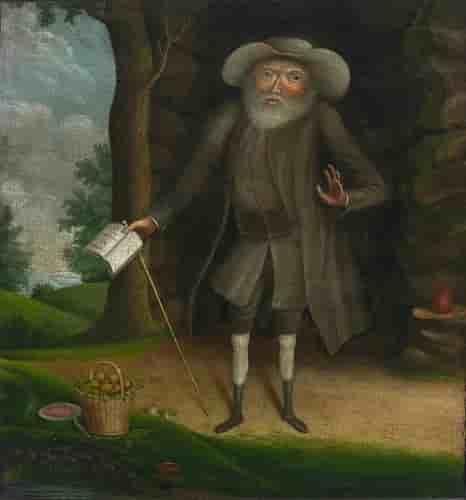
Benjamin Lay stormed a Quaker service in 1738 with a sword and a Bible filled with fake blood, and almost no one remembers him today.
Hey everyone! For quite a while now, I’ve been working on a manuscript about the history of abolitionism, the centuries-long fight to end slavery. Today I’d like to share one of the first chapters, and I’m very curious to hear what you think!
Subscribe
On 17 September 1738, in the American village of Burlington,1 a small, hunchbacked man came storming into a church service. He had a large head, short spindly legs, and wore a long coat under which he seemed to be hiding something. The worshippers, lost in silent prayer, looked up in alarm as the man rushed to the front and dropped down onto one of the foremost benches.
Everyone present belonged to the Religious Society of Friends, better known as the Quakers. Heretics, really. They had been dismissed with the mocking nickname “Quakers” because they tended to shake and quake rather loudly during prayer — and because they held some rather radical ideas. The Quakers had split from the official Church of England in 1647 and been brutally persecuted, after which many fled to North America.
That day in Burlington, the most prominent Quakers were in attendance. Among them were lawyers and notaries, merchants and landowners. Many were rich; some were fabulously rich. And the main source of their wealth? The slave trade.
The service had been going on for a while when the little man finally rose to his feet. Quakers have no ministers or priests, which means anyone who feels the calling may speak. And this visitor felt the calling. He began to speak — or rather, to preach — proclaiming that everyone is equal in the eyes of God, whether you are poor or rich, man or woman, white or black. He cried out that slaveholders were the greatest sinners on earth, or worse: the henchmen of Satan.
At that moment, the man threw off his long coat. A shock went through the room as it became clear he was wearing a military uniform and a great sword. He also produced a Bible and shouted: “Thus shall God shed the blood of those who enslave their fellow human beings!”2
What happened next would be retold for years. The man drove the sword through the book. The Bible tore open and blood spurted out. It gushed over his arms and splattered across the faces of the most important Quakers in the front row. Chaos. Screaming. People fainted left and right, while the little man stood perfectly still, “like a statue,” as one eyewitness would later report. He was seized and dragged out of the building.
None of the Quakers, not one member of that radical sect, could have suspected that a historic moment had just taken place. No one knew that 17 September 1738 would go down in history as a turning point. A spark became a flame, the flame became a fire, and the fire set the world ablaze. The fuse had been lit by a hunchbacked prophet with dwarfism. He was a heretic among heretics, a man who has been described as “the most radical person on the planet.”3 His name was Benjamin Lay, and it is a scandal that not a single statue has ever been raised in his honour.
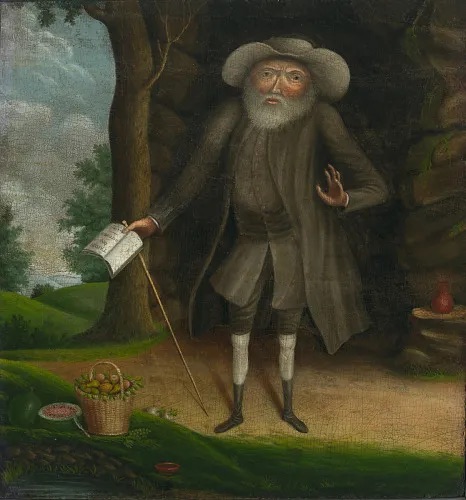 William Williams’s portrait of Benjamin Lay, painted for Benjamin Franklin. It was rediscovered at a local auction in August 1977, covered in dirt after decades in a barn.
Imagine you wake up tomorrow in a world where slavery has returned. You open the newspaper, and there, between the ads for laundry detergent and ground beef, you suddenly come across a different sort of offer:
FOR SALE. Cleaning woman, 20 years old, vaccinated. Comes with infant.
Dazed, you walk outside, past shop windows where, alongside shoes and jeans, you see advertisements for “iron padlocks, for dogs or for slaves.” You see handcuffs and leg irons, thumbscrews, and a strange instrument with which — the shopkeeper explains enthusiastically — you can crank open a slave’s mouth if he refuses to eat.
You visit friends who turn out to have a new member of the household: Napoleon. At first you assume it’s a dog, but when he walks in with bowed head and a tray, it dawns on you. “Just set the coffee down here, Napoleon,” your host laughs.
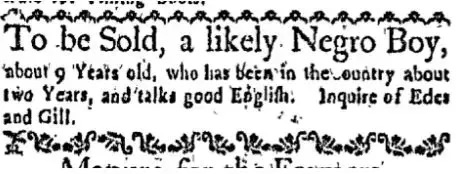 Supplement to the Boston-Gazette, March 16, 1767.
Supplement to the Boston-Gazette, March 16, 1767.
This was the world Benjamin Lay woke up to every single day. A world where the newspapers were full of advertisements for slaves. A world where shopkeepers ran ads for padlocks “for Blacks or for Dogs,” or for a speculum oris, an instrument for prising open the clamped-shut mouth of a slave. A world where many a slave was named after a Roman emperor, a French king, or a British prime minister — the way plenty of pet owners today think it’s funny to call their dog “Caesar,” “Napoleon,” or “Donald.”4 [?]
At the start of the eighteenth century, slavery was utterly normal across great swaths of the world. The ruling class found it perfectly logical that you could own and sell other people, just as you could breed and trade chickens and pigs. That another human being could be your property was simply part of life, like rain and sunshine, sickness and death. It had always been so, in every country and every corner of the globe, since the dawn of recorded history. Until the year 1800, fully three-quarters of the world’s population was forced to labour for someone else, as a serf or a slave.5
Forced labour and slavery were normal in Africa and India, in China and the Arab world. It was widespread among the peoples of North America, from the Cherokee to the Chickasaw, and it was the norm in the Russia of the tsars. The ancient Greeks and Romans had thought nothing of keeping slaves, and so had the Maya, the Aztecs, and the Inca on the other side of the ocean.
From 1492, when Columbus set foot on the Bahamas, the Europeans had begun building one of the largest and most brutal slave empire in history. The scale of the oppression was extraordinary. In the end, the British, Dutch, Spanish, Portuguese, French, and Danes would ship a 12 million Africans across the ocean in slave ships. That was 35,000 slaving voyages over 350 years. While distinguished philosophers wrote treatises on “the rights of man,” wealthy merchants were buying millions of people on the coast of Africa to ship them off to the “New World.”
Behold: a world in which it was not slavery but freedom that was the exception. For centuries, the world economy ran on forced labour. If, three hundred years ago, you had stood on a street corner in London or Amsterdam, Paris or New York, and declared that slavery had to be abolished, you would have been laughed off the street. A rare soul might, in theory, have agreed with you — but found the practical objections insurmountable. Because if one country abolished slavery, wouldn’t another simply take over the trade? And wasn’t slavery the very thing keeping the economy afloat?
One British merchant praised the slave trade as “the foundation of our economy … and the chief cause of our national wealth.”6 The popular author James Boswell believed that abolishing slavery would be “an extreme cruelty to the African savages,” since it spared them from “massacre or intolerable bondage in their own country.”7 Even the former slave Jacobus Capitein (1717–1747), the first black minister in the Netherlands, fell in line with the prevailing view that slavery could be justified and was “not contrary to Christian liberty.”8
Meanwhile, philosophers, freethinkers, and intellectuals who were perfectly happy to keep slaves were everywhere you looked. The great philosopher Aristotle had written that some people are slaves by nature. The Church father Augustine maintained that slavery was tragic but inevitable. And the philosopher Immanuel Kant noted that black people are lazy by nature, and “made” for the brutal conditions of the Caribbean sugar plantations.9
Or take the revolutionary Founding Fathers of the United States. George Washington had nine of his rotten teeth replaced with nine teeth pulled from the mouths of slaves.10 Thomas Jefferson declared “that all men are created equal” and yet owned six hundred slaves — four of them his own children.
Yes, a few had their doubts. Jefferson’s conscience kept gnawing at him, and Kant grew somewhat more critical of the colonial project in later years. But what stands out most today is the hypocrisy of all those so-called freethinkers. The British philosopher John Locke called slavery “so vile and miserable,” so “opposite to the generous temper” of his nation, that he could “scarcely conceive” of “an Englishman, much less a gentleman, pleading for it.” And yet Mr Locke invested a small fortune in the slave trade of the Royal African Company.11
No less hypocritical was his French counterpart, Voltaire. On paper, Voltaire opposed slavery — but he couldn’t hide his delight when, in 1768, a slave ship was named after him.12 In 1789 the French Revolution broke out under the banner “Liberté, égalité, fraternité” — and several slave ships were promptly rechristened: Liberté, Égalité, and Fraternité.
No, there was no prominent thinker who explicitly defended slavery. No white man wrote a long book laying out the best arguments for kidnapping, trading, and exploiting millions of fellow human beings. But neither was there anyone who took the trouble to really criticise it. Apparently it was too risky to attach your reputation to so radical a cause. And so it never went beyond pinpricks.
The famous British writer Samuel Johnson caused a minor scandal by raising a toast, at an elegant Oxford dinner, to “the next insurrection of the negroes in the West Indies.”13 But his protest went no further than that. Slavery was distasteful — but really, what was there to be done about it?
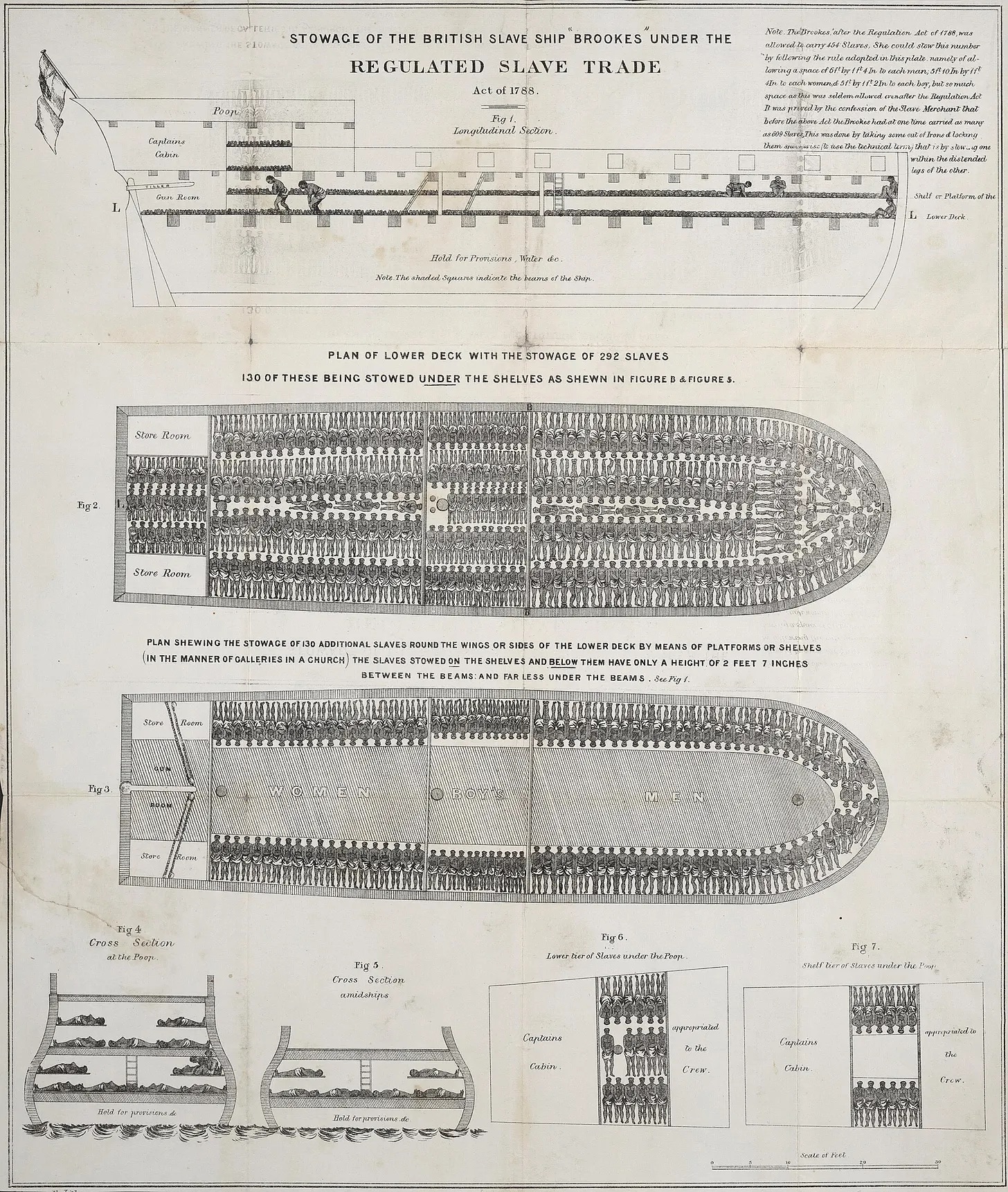 Plan of the British slave ship Brooks, 1788.
Benjamin Lay was born on 26 April 1682, in a dark hovel in the English village of Copford. That he was different from other people must have been obvious from the start. He had a large head, a hunched back, and a chest that jutted sharply forward. We don’t know much about his childhood, except that he grew up poor. His parents had no money to send him to school, so Benjamin taught himself to read and write. As a teenager he worked as a shepherd; in his twenties he went to sea as a sailor. For years he lived on the water, coming to know humanity “in all Nations, Colours, and Countries.”14 Benjamin called himself a citizen of the world.
Around 1714 the little man settled in London. What he got up to in those years we know mostly thanks to the records of the Quakers, who minuted their meetings in meticulous detail (something historians remain grateful for to this day). Benjamin turned up in the minutes regularly, and usually the subject was his misconduct as a member of the congregation. He had a habit, you see, of storming into services and loudly broadcasting his opinions. Above all, Benjamin loathed wealthy Quakers who “thought highly of their own achievements, and highly of all the great good they were doing.”15
It wasn’t long before the little man was on the verge of being expelled. But as it turned out: some people just refuse to be cancelled. The sociologist Albert Hirschman wrote, in his classic Exit, Voice, and Loyalty (1970), that the members of any organisation — be it a school, a company, or a football club — essentially have two options when they feel their community is going downhill: exit or voice. Leave, or speak up. It’s easier to pack your bags when things aren’t going your way. But loyal people, Hirschman wrote, would rather raise their voices. And Benjamin was loyal to the bone. He loved the Quakers, and that was precisely why he couldn’t bring himself to leave.
In 1718 he married Sarah Smith, a fellow believer who also had dwarfism. Since Benjamin had by now fallen out with just about every Quaker in London, leaving the capital seemed the sensible thing to do. Sarah and Benjamin had heard there was a small community of Quakers on Barbados, an island in the Caribbean. In the autumn of that year, they set sail.
Full of good cheer, the newlyweds opened a little grocery shop in the harbour of Bridgetown, the capital of Barbados. What they didn’t yet know was that this place — with its swaying palm trees and white sand beaches — was hell on earth.
Barbados was one of the most important colonies of the British Empire. On this tiny island lived 80,000 people, three-quarters of them enslaved. When we think about slavery, we tend to picture the thirteen North American colonies, from Pennsylvania to Virginia. But Caribbean slavery was bigger, more brutal, and more lucrative. And that had everything to do with the “white gold” of the colonial age: sugar.
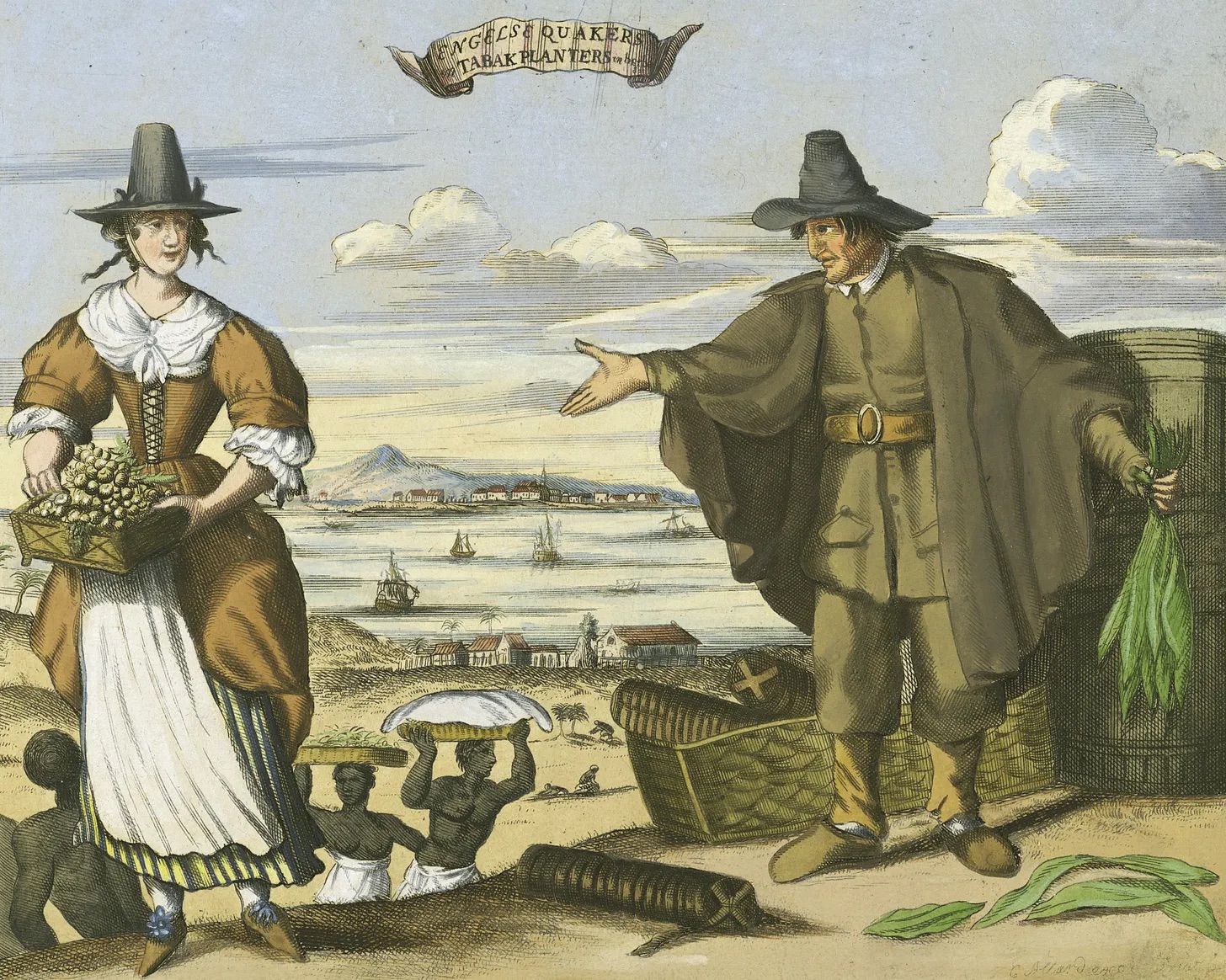
English Quakers and tobacco slaves farmers in Barbados. By Pieter vander Aa.
For centuries, sugar had been a luxury only the nobility could afford. But in the sixteenth century, Europeans brought sugarcane to the Americas, where it grew astonishingly well. The Caribbean in particular became the sweet shop of the world. A full 60 per cent of all the Africans who survived the brutal voyage across the Atlantic ended up in the Caribbean.16
For the white plantation owners, the sugar trade was magnificent. They lived in luxurious villas with grand balconies and dazzling views over the Caribbean Sea. There they gorged themselves on the most decadent meals. So decadent that even an English lady of standing was scandalised on her first visit to one of the colonies. The wife of the governor of Jamaica wrote in her diary:
“I never saw such eating and drinking in my life! … I saw some in the company … eat as though they had never eaten before — a tea course, then a full coffee spread, a large glass of red wine, another large glass of punch; then a glass of madeira, sangaree, hot and cold meats, stews and roasts, hot and cold pickled and plain fish, pepper, candied ginger, citrus fruits, sweet jellies — the whole thing was as astonishing as it was revolting.”17
This, by the way, was breakfast.
For the black slaves, life on the sugar plantations was wretched through and through. Olives, grapes, cotton, tobacco, coffee — in terms of working conditions, almost anything was better than sugar. The labour in the Caribbean was insanely hard. During the five-month harvest season, people had to toil eighteen hours a day in the blazing sun. And while the plantation owners stuffed themselves, the slaves’ diet consisted of, at most, a few potatoes, some maize, and (often rotten) salted herring or dried cod.
The heaviest work was done mostly by women. The result: as many as half of them became infertile. Worse still, a third of all slaves died within three years — of malnutrition, tropical disease, or suicide. And so a constant supply of new slaves was needed, or the population would shrink by 3 per cent a year. “The Caribbean,” one historian observes, “was a slaughterhouse.”18
Behind the dry figures lies a reality almost impossible to grasp. When slavery was abolished in the United States, an imported population of roughly 400,000 African slaves had multiplied tenfold, to nearly four million. When the same thing happened in the British Caribbean, an imported population of more than two million had shrunk to just 670,000 souls. The local plantation owners found it, in their own words, “cheaper to buy than to breed.”19
This was the hell that Benjamin and Sarah Lay arrived in, in 1718. They saw people literally collapse in the street from hunger and thirst. Their shop was besieged by desperate people begging for a little food and water. At first Benjamin would still get angry when they pinched something, and once he even lashed out. But before long he was overwhelmed by guilt and remorse. Soon after arriving, Benjamin got to know a man who was flogged by his master every Monday morning. “I can’t take it any longer,” the man sighed, and later Benjamin learned that one Sunday evening the man had taken his own life.20
Another day, Sarah was visiting fellow believers when, beside their house, she saw a naked black man hanging from a chain. Beneath his trembling body lay a pool of blood. Sarah fled inside and asked her Quaker friends what this meant. They showed not a flicker of remorse and snorted that the wretched slave had had the nerve to run off and hide for two days. Sarah and Benjamin were sickened by all the injustice they witnessed. They began inviting slaves into their home. Before long, hundreds of people were turning up at these gatherings — to the fury of the ruling class on Barbados. “Sugar is made with blood,” Benjamin now understood. And he asked himself: “Oh, when will there be an end to these things?”21
After almost two years, the ground grew too hot under Benjamin and Sarah’s feet, and they returned to London. But what they had seen on Barbados, they would never forget.
To understand the phenomenon that was Benjamin Lay, there is one more thing you need to know about the sect he belonged to. The Quakers.
We are talking here, without exaggeration, about one of the most important sects in human history. There were never very many Quakers (around 1660 there were some 60,000 of them, less than 1 per cent of the British population),22 but without those strange heretics the world today would look very different.
Seventeenth-century England was crawling with radical little factions. There were the Levellers, who believed all power should go to the people; the Seekers, who said the official church was thoroughly corrupt; the Diggers, who insisted the land should become everyone’s common property; and then there were the Ranters, who believed you could reach heaven through drinking, smoking, fornicating, and swearing. What all these radicals had in common was a deep aversion to authority. They would not be dictated to by a prince or a priest, a king or a pope. And in the 1650s, many of these troublemakers joined the Quakers, who were perhaps the most radical of the lot. To give you an idea: Quakers ran naked into churches and publicly set Bibles on fire.
If the Quakers had a single dogma, it was equality. They refused to bow or kneel, even face to face with the king. They took their hats off for no one and flatly refused to address noblemen as “my Lord.” They would swear no oath of loyalty to anyone, and certainly no oath at all, since Quakers claimed always to speak the truth. Military conscription? Away with it. Church taxes? Forget it. Ministers and priests? No need for them at all — everyone could build their own bond with God. Church buildings could be torn down too, for the Lord drew no distinctions of location. Every place was equally holy, and you could just as well hold a service in a stable or a barn.
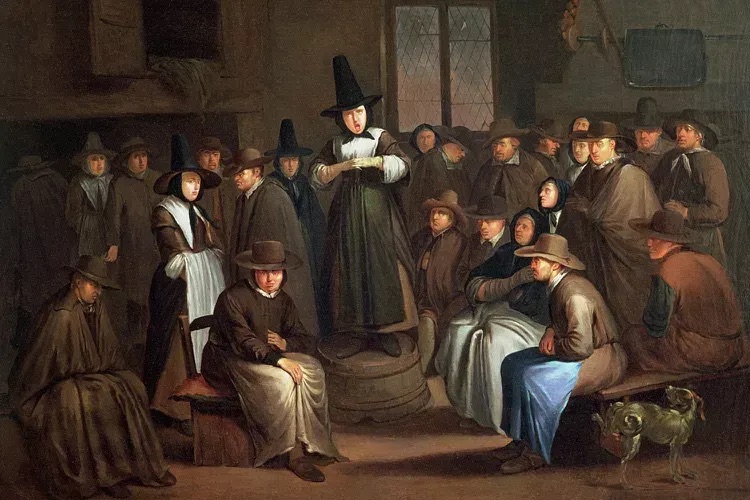 Painting of a Quaker meeting by Egbert van Heemskerk the Elder.
Painting of a Quaker meeting by Egbert van Heemskerk the Elder.
The Quakers had no truck with holidays like Christmas or Easter, because all days were equal. And when someone was buried, there was certainly no headstone — that was mere vanity. Quaker equality extended to women, too, who — exceptionally for the time — could hold positions of leadership. Fully one in five (!) of all the books written by women in seventeenth-century England came from the pen of a Quaker.23 Quaker women served as preachers and prophets, missionaries and martyrs, organisers and political activists.24
In no time, the heretics became notorious for disrupting church services across the country. They would slip inside, wait for the minister to start speaking, and then begin yelling at the man to shut his trap. Quakers travelled the world to convince anyone and everyone of their faith. One of them secured an audience with the sultan in Constantinople; another gave the pope in Rome a piece of his mind (“Thou art truly the Antichrist!”). That last one was hanged the next day.
This, in short, was the tradition Benjamin Lay drew on. By his own time, more than fifty years later, most Quakers had grown a good deal more conservative — as radical movements so often do. A ruling class of old men had come to power, dictating how the faith was to be practised. But Benjamin would not be told what to do. He devoured the old books of the first Quakers. And from the moment he and Sarah were back in London, he followed in their footsteps once more. Which is to say: he started barging into services again. And so he landed in trouble again, not least for calling a prominent Quaker a “drunkard” and a “swine.”25
Benjamin was expelled by his congregation in London, after which he and Sarah moved to Colchester (northeast of London), where he was expelled too. It was time to move on again. For years Benjamin and Sarah had dreamed of a journey to Pennsylvania, the “Holy Experiment” of their fellow Quaker William Penn in America. Benjamin had high hopes for that colony, home to the largest Quaker community in the world. He called Pennsylvania “that good land” and imagined it a place of “the greatest freedom.”26
In March 1732, the Lays boarded the three-masted Elizabeth and Dorothy, bound for Philadelphia. Even during the voyage, it began to dawn on him that Pennsylvania might not be the paradise Benjamin had hoped for. From the sailors he heard horrifying stories about the slave trade. And on arrival, Benjamin watched Africans being bought and sold on the docks of that “City of Brotherly Love.” As it turned out, more than half the Quakers in Benjamin and Sarah’s new congregation owned slaves. The slaves had to plough and sow, thresh and weed, chop wood and clear land, while their masters leaned back with their “lazy, godless bellies.”27
Benjamin was disgusted. And, as it happened, he was not the only one. For there lived in Philadelphia another Quaker who was fiercely opposed to slavery: Ralph Sandiford. A few years earlier, this Sandiford — also a man of short stature — had written a pamphlet against slavery. Like Benjamin, he believed the slave trade was the greatest sin of the age, but he had paid a high price for that conviction. The Quaker elders had banned his book and made his life a misery. By the time Benjamin first met Sandiford, the latter was already ill and weakened. He had fled his tormentors and was living in a log cabin northeast of the city. The two men had intimate conversations about their faith, and Benjamin sat as a friend at Sandiford’s bedside when he died at the age of forty. He died “in great confusion of mind,” Benjamin later wrote, for “oppression … can make a wise man mad.”28
Benjamin was determined to carry on Sandiford’s fight. Yes, there had been people before him who protested against the excesses of slavery. Yes, there had been earlier pleas for better treatment of slaves, or for freeing them once they had converted to Christianity. And yes, history was full of resistance by the enslaved, who tried again and again to throw off their chains. On as many as one in ten slaving voyages across the Atlantic, a revolt broke out. But the bitter truth is that, for centuries, the victims of the system had no power to bring it down.29
So the notion of “abolitionism”? The idea that the entire institution of slavery could be abolished — once and for all, and everywhere? That was new. No one had ever proposed it before. Or at any rate, no one had seriously fought for it — until the first Quaker radicals began their long struggle, with Benjamin Lay at the front.
For Benjamin, no compromise was possible. He branded slaveholders “Beasts, Blasphemers, Liars, Thieves, and Murderers, and Idolaters too.”30 Those repulsive, stinking-rich Quakers with their bloated bellies, preaching their false doctrine from the front benches — they were the virus that had poisoned the pure faith. Benjamin launched a years-long campaign to shake his fellow believers awake. He smashed teacups if there was sugar in them. He started shouting whenever a slave-owning Quaker rose to speak. He called them parasites and friends of Satan. Benjamin was expelled twice more, and a kind of Quaker police force was even set up to make sure he could no longer get into a single service anywhere in Philadelphia. And wherever he went, Benjamin was laughed at. The hunchbacked prophet was written off as a fool, an idiot, a madman who had lost his mind.
But the hunchbacked prophet would not be stopped. When he had been thrown out into the street for the umpteenth time, he lay down in the mud in front of the entrance, so that everyone had to step over his body. Another day, he kidnapped the child of slaveholders, to make them feel what it is to have your own offspring taken from you.
Benjamin grew more radical still when Sarah, his anchor and his great support, died in 1735. He moved to a cave near Abington, north of Philadelphia, where he lived as a hermit. He made his own clothes and grew his own food. He refused to consume anything made with slave labour, and he was just as fiercely opposed to the exploitation of animals. Benjamin used no sheep’s wool and always travelled on foot, because he would not exploit horses. The little man was a vegan, two centuries before the word was even invented.31
For Benjamin, it all formed part of a single, coherent worldview. To him, all creatures were fellow creatures.32
He reasoned his way through from first principles, and changed not only the world but himself. Benjamin Lay was “a class-conscious, race-conscious, environmentally conscious ultraradical,” writes the historian Marcus Rediker in his magnificent biography. “Most of us would assume this combination of convictions only became possible in the 1960s, two centuries after the end of Lay’s life. … In his own day, Lay may well have been the most radical person on earth.”33
Physically, Benjamin was a dwarf. Mentally, he was a giant.
In his cave near Abington, Benjamin set to work on his book. For more than two years, the self-taught man laboured over his tirade against slavery and the Quaker elders. “Time for those old rusty candlesticks to clear off,”34 he fumed. Benjamin believed that many more Quakers were against slavery, but that most kept their mouths shut to keep the peace.
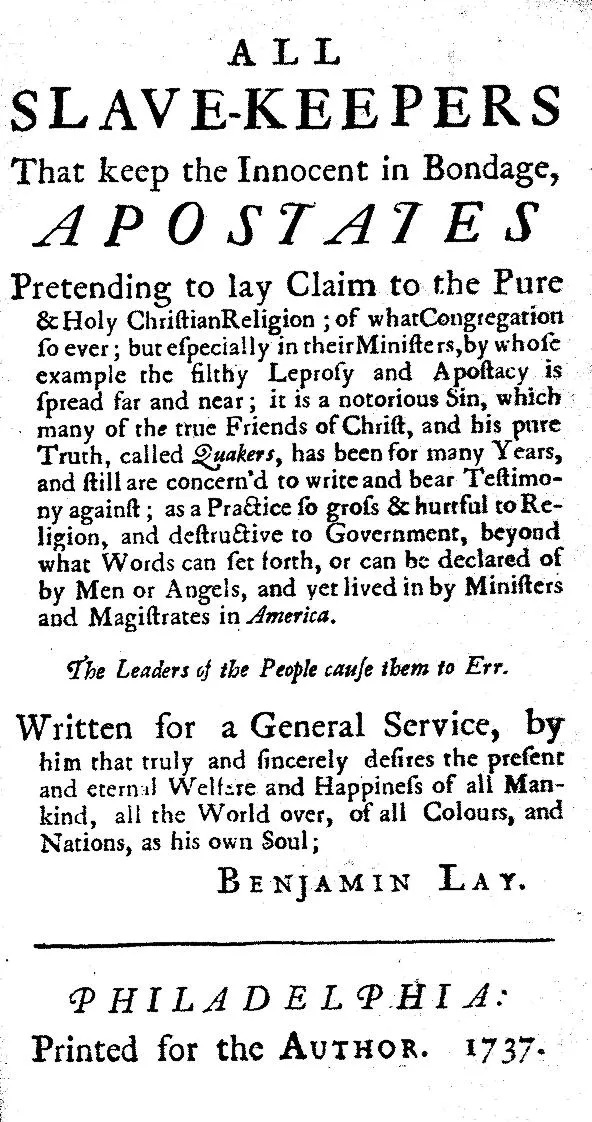 The title page of Benjamin Lay’s book.
In July 1738 the book was finished, and six weeks later it was published by none other than Benjamin Franklin, the legendary Founding Father of the United States. As a young man, Franklin had owned slaves himself, but in later life he became a cautious abolitionist — so cautious that he had his name removed from the title page.
Soon after publication, Benjamin set off for Burlington, the small village where the most important Quakers of Pennsylvania held their annual meeting on 17 September 1738. The little man wore a long coat, and beneath it a military uniform, a great sword, and a Bible. Inside the Bible, he had hidden a pig’s bladder, filled with redcurrant juice.
Subscribe
Today, Benjamin Lay is all but forgotten. If he appears in the history books at all, he is usually described as an odd character who wasn’t quite right in the head. To the general public he is completely unknown. There isn’t even an alleyway named after him, let alone a statue raised in his honour.
But in his own day, Benjamin was a phenomenon. “There was a time,” wrote Founding Father Benjamin Rush, “when the name of this celebrated Christian philosopher … was known to almost every man, woman, and child in Pennsylvania.” According to Rush, Benjamin stood at the root of a revolution, and taught “the benefactors of mankind not to despair if they do not live to see the fruits of their benevolent proposals or undertakings.”35
After Benjamin came countless abolitionists who carried on his work. Many were Quakers, and many hung a portrait of Benjamin on their wall. Some of them were, of all people, the children of the very Quaker elders against whom Benjamin had raged. “It was almost certainly Ralph Sandiford and Benjamin Lay,” one historian notes, “who, in the 1730s and 1740s, changed the hearts and minds of a younger generation.”36
In 1775 the first American anti-slavery organisation was founded, with Anthony Benezet among its founders — a good friend of Benjamin’s, and considered by historians to be perhaps the most important white abolitionist of all.37
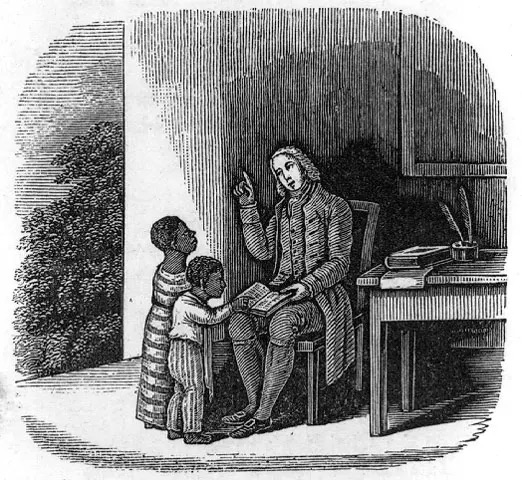 “Benezet instructing colored children”. By: John Warner Barber (1850).
Thirty years younger than Benjamin, Benezet likewise lived simply, refused to consume products made by enslaved hands, and — remarkably enough — also became a vegetarian. The writings of Benjamin and Benezet, in turn, had a profound influence on British activists such as the young Thomas Clarkson, who at the age of twenty-five resolved to devote his life to the fight against slavery. In 1787 he founded, in London, the Society for the Abolition of the Slave Trade; nine of the eleven other founders were Quakers. The British campaign against the slave trade would grow into one of the most successful movements in history, but that is a story for another article.
When Benjamin was eighteen, in the year 1700, around 70 per cent of the Quaker elite in Pennsylvania still owned slaves. Fifty years later, that had fallen to 10 per cent.38 In 1758 the Quakers of Philadelphia resolved to expel all slave traders from their community. Owning slaves was still permitted (and would remain so for another eighteen years), but the first step had been taken. When Benjamin heard this news, only a few weeks before his death, he was silent for a moment. Then he stood up and said: “Thanksgiving and praise be rendered unto the Lord God.” And he added: “I can now die in peace.”39
Benjamin was buried in an unmarked grave, beside Sarah, the great love of his life.
“Let your lives speak,” goes an old Quaker motto. Few lives ring out as loudly as that of Benjamin Lay. It is high time we told his story again. Because if it is true that so many people, for so long, were so blind to an injustice as vast as slavery, then it raises the question of what we are still blind to today. What will our descendants look back on with horror? And who are the Benjamin Lays of our own time?
Thank you so much for taking the time to read this article. To receive new posts and support my work, consider becoming a free or paid subscriber.
Subscribe
P.S. Would like to read more about Benjamin Lay? I highly recommend this amazing biography_, written by the historian Marcus Rediker.
P.S. 2 The original Dutch version of this essay was published in De Correspondent. You can read it here.
1
Burlington lies northeast of Philadelphia, in the state of New Jersey.
2
Marcus Rediker, The Fearless Benjamin Lay: The Quaker Dwarf Who Became the First Revolutionary Abolitionist (2017), p. 2.
3
Marcus Rediker, The Fearless Benjamin Lay (2017), p. 150.
4
The main source for this section is Bury the Chains: The British Struggle to Abolish Slavery(2005) by Adam Hochschild. See p. 2 (three-quarters of the world’s population enslaved or in serfdom), p. 51 (silver padlocks), p. 118 (speculum oris), and p. 34 (slaves named after emperors).
5
Adam Hochschild, Bury the Chains: The British Struggle to Abolish Slavery (2005), p. 2.
6
Adam Hochschild, Bury the Chains (2005), p. 14.
7
James Boswell, The Life of Samuel Johnson (1791).
8
Jacobus Capitein, Staatkundig-godgeleerd onderzoekschrift over De Slaverny, als niet strydig tegen de Christelyke Vryheid (1742).
9
Pauline Kleingeld, “Kant’s Second Thoughts on Colonialism” (2014), p. 10.
10
Jill Lepore, These Truths: A History of the United States (2019), p. 120.
11
John Locke, Two Treatises of Government (1689), p. 7.
12
Adam Hochschild, Bury the Chains (2005), p. 87.
13
James Boswell, The Life of Samuel Johnson (1791).
14
Benjamin Lay, All Slave-Keepers That Keep the Innocent in Bondage, Apostates (1737).
15
Benjamin Lay, All Slave-Keepers That Keep the Innocent in Bondage, Apostates (1737).
16
Adam Hochschild, Bury the Chains (2005), p. 55.
17
Philip Wright (ed.), Lady Nugent’s Journal of Her Residence in Jamaica from 1801 to 1805 (1966), p. 57.
18
Adam Hochschild, Bury the Chains (2005), p. 67.
19
Adam Hochschild, Bury the Chains (2005), p. 67.
20
Marcus Rediker, The Fearless Benjamin Lay (2017), p. 34.
21
Marcus Rediker, The Fearless Benjamin Lay (2017), p. 35.
22
Pink Dandelion, The Quakers: A Very Short Introduction (2008), p. 13.
23
Patricia Crawford, “Women’s Published Writings 1600–1700,” in Mary Prior (ed.), Women in English Society 1500–1800 (1985).
24
Catie Gill, Women in the Seventeenth-Century Quaker Community: A Literary Study of Political Identities, 1650–1700 (2005).
25
Marcus Rediker, The Fearless Benjamin Lay (2017), p. 36.
26
Marcus Rediker, The Fearless Benjamin Lay (2017), p. 49.
27
Marcus Rediker, The Fearless Benjamin Lay (2017), p. 56.
28
Marcus Rediker, The Fearless Benjamin Lay (2017), p. 58.
29
Source: Christopher Leslie Brown, “Abolition of the Atlantic slave trade,” in Gad Heuman and Trevor Burnard (eds.), The Routledge History of Slavery (2011), pp. 282–283.
30
Source: Marcus Rediker, The Fearless Benjamin Lay (2017), p. 60.
31
It is striking how many abolitionists were also vegetarians and advocates of animal rights. Among the most famous were John Woolman, Anthony Benezet, William Wilberforce, Elizabeth Heyrick — and yes, Benjamin Franklin too, the first person to use the word “tofu” in the English language.
32
Marcus Rediker, The Fearless Benjamin Lay (2017), p. 149.
33
Marcus Rediker, The Fearless Benjamin Lay (2017), p. 80.
34
Marcus Rediker, The Fearless Benjamin Lay (2017), p. 3.
35
Marcus Rediker, The Fearless Benjamin Lay (2017), p. 130.
36
Brycchan Carey, From Peace to Freedom: Quaker Rhetoric and the Birth of American Antislavery, 1657–1761 (2012), p. 190.
37
Christopher Leslie Brown, “Abolition of the Atlantic slave trade,” in Gad Heuman and Trevor Burnard (eds.), The Routledge History of Slavery (2011), p. 284.
38
Jean R. Soderlund, Quakers and Slavery (2014), p. 34.
39
Marcus Rediker, The Fearless Benjamin Lay (2017), p. 120.