Rutger Bregman argues that 40 percent of Harvard graduates end up in consultancy, finance, or corporate law, and that moral ambition, not awareness, is what the world's hardest problems actually need.
About a quarter of Harvard graduates end up in consultancy, finance, or corporate law. That number has hovered around 40 to 45 percent in recent years. And whatever you think about those careers individually, as an allocation of collective talent, it should give us pause. These are people who wrote application essays about ending world hunger, fixing democracy, solving climate change. Something happened between the essay and the job offer.
That's the question Rutger Bregman came to Harvard to ask. Bregman, the Dutch historian and author of Moral Ambition, has spent years in what he calls the "awareness industry," writing op-eds and books, going viral at Davos by telling billionaires they don't pay their fair share in taxes. At some point, he started wondering whether any of it was working. The answer he arrived at was uncomfortable: awareness is vastly overrated, and what we actually need is something different.
He calls it moral ambition.
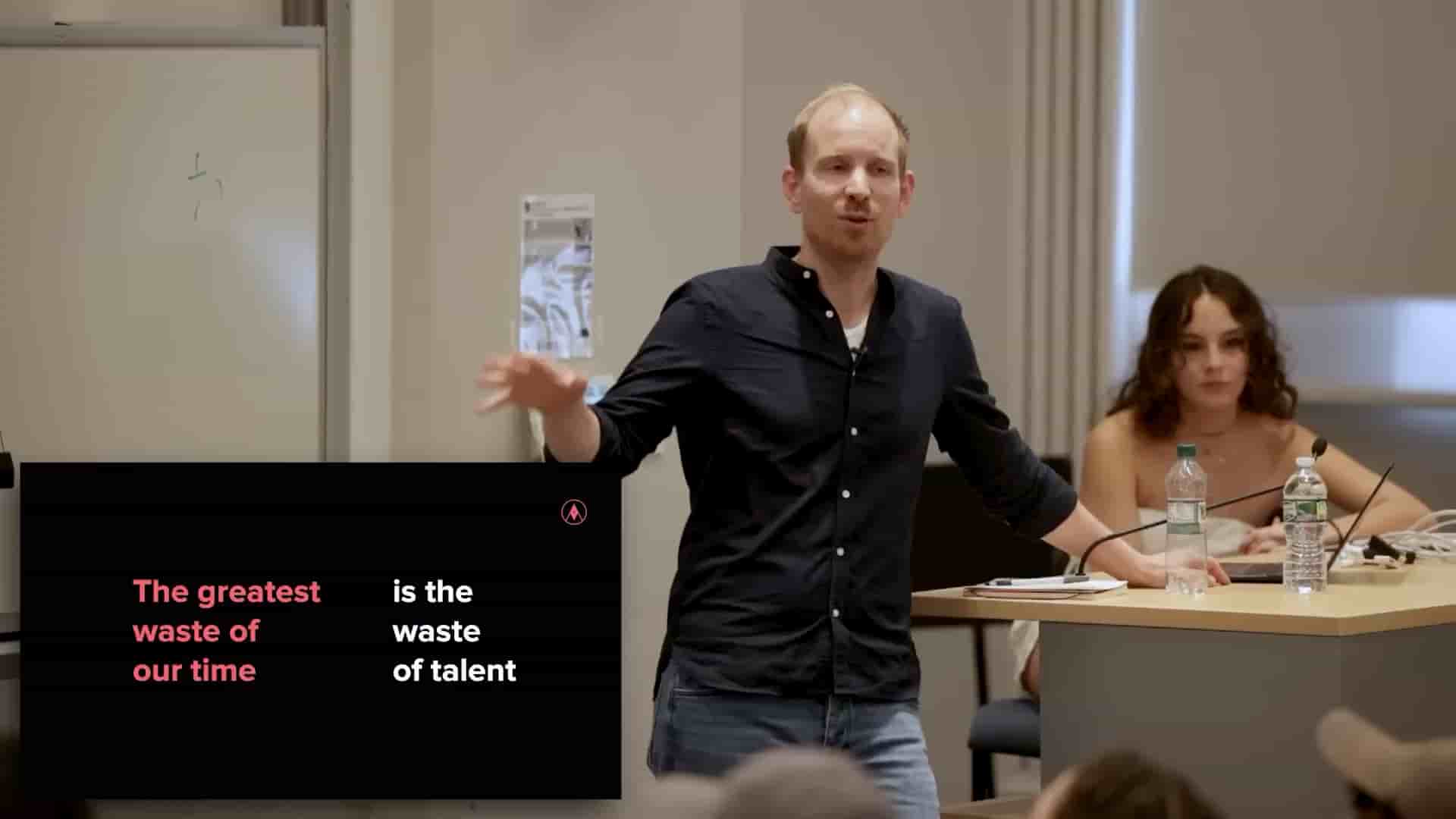
The waste that bothers Bregman most is not the waste of money or time. It's the waste of talent. A recent study by two Dutch economists found that roughly 25 percent of workers in modern economies believe their own jobs are socially meaningless. The academic term for this, he notes with some pleasure, is a "bullshit job." What's striking is which jobs show up disproportionately in that category: not the teachers, the nurses, or the care workers, who tend to find their work meaningful. The overrepresentation is among people with beautiful LinkedIn profiles, prestigious degrees, and high salaries.
"The Bermuda Triangle of Talent is consultancy, finance, and corporate law. It's this dark chasm that sucks up so many of our best and brightest. And we never hear from them again."
That's the trap Bregman wants to name and then dismantle. Not by shaming people who took those jobs, but by changing what counts as prestigious in the first place. He's observed that calling someone greedy doesn't land. Calling their career boring does.
Moral ambition, as Bregman defines it, is four things at once: the ambition of an entrepreneur, the idealism of an activist, the scientific rigor of a scientist, and the humility of a monk. He acknowledges that's a rare combination. But the pairing that matters most, he argues, is the first two: entrepreneurial drive combined with genuine idealism.
When he studied the great moral pioneers of history — the abolitionists, the suffragettes — that's what he found. Thomas Clarkson, one of the founders of the British abolitionist movement, entered a Cambridge essay contest in 1785 on a whim. The prompt: is it acceptable to own and sell other human beings? Clarkson won the prize, rode back to London, and somewhere near the village of Wade's Mill had a realization that would consume the next six decades of his life. If what he'd written in that essay was true, shouldn't someone do something about it?
He spent 35,000 miles traveling across Britain in the first seven years alone, spreading abolitionist literature, building the case. He eventually had a complete nervous breakdown. Couldn't walk the stairs. Couldn't speak without sweating profusely. He burned out at 33. But Bregman's point is a sharp one: he burned out while doing something that deeply mattered. Most people, he suggests, will burn out anyway. The question is whether it will be on something worth the fire.
It would be nice to get a burnout while you work on stuff that's actually important.
There's another detail from the abolitionist story that Bregman finds significant: of the 12 founders of the British Society for the Abolition of the Slave Trade, 10 were entrepreneurs. People who had built and scaled their own companies, accumulated real wealth, and then chose to aim all of it at one of history's great moral problems. It wasn't writers and intellectuals who led the most successful abolitionist movement in history. It was builders.
Bregman offers three concrete ingredients for living a morally ambitious life.
First: redefine success. He quotes Ellen Rain's observation that people spend their whole lives climbing the ladder of success only to find, at the top, that the ladder was leaning against the wrong wall. The good news for students is that they haven't climbed very far yet. They are, as he puts it, still writing the constitution for the next few decades of their lives. The goal isn't to make people feel guilty for wanting status and prestige. It's to redirect those desires toward things worth wanting. Status is one of the most powerful currencies in elite environments. We've just made the wrong things high-status.
Second: focus on maximum impact. Bregman is direct about this in a way that can sound almost satirical. If you help one person, that's great. If you help two, that's twice as much. This is called mathematics. His point, beneath the joke, is that winning is a moral duty. Noble losers who stood on the right side of history while losing every election are not, in his view, a model to emulate. Ambition in the service of good causes is not a character flaw.
For identifying which causes deserve attention, he proposes what he calls the SSS framework: problems that are sizable, solvable, and sorely neglected. Climate change scores high on the first two but lower on the third, at least compared to 50 years ago. Within climate, food systems, which account for about 20 percent of emissions, are far more neglected. Factory farming he describes as one of the greatest ongoing moral atrocities of our time. Governments have invested roughly $1.5 billion in alternative proteins, a rounding error compared to what's flowed into clean energy and electric vehicles.
Go where others don't go. Find the gap in the market. That's how entrepreneurs think, and it's how morally ambitious people should think about causes.
Third: follow the Gandalf model. Don't ask yourself what your passion is. Ask the world what it needs. In Tolkien's story, Gandalf doesn't knock on Frodo's door and say, "Hey, what are you passionate about?" He says: there is a ring, there is a mountain, go throw it in. If Frodo had followed his passion, he probably would have been a gardener. The morally ambitious person finds a wise advisor who has thought hard about which problems are most pressing, and lets that shape the work rather than gazing inward for some pre-existing calling.
Bregman anticipates the objection from the left: isn't this all too focused on individual agency? Doesn't it ignore structural injustice? He takes the concern seriously. The self-help genre's fantasy of pulling yourself up by bootstraps is genuinely pernicious, and he says so. But he also names what he calls the left-wing excuse: the tendency to demand systemic change loudly and often, while avoiding any personal reckoning with one's own choices. Overthrow the patriarchy, destroy capitalism, tax the rich — and also, continue doing exactly what you were doing.
"Everyone says, who wants change? All the hands go up. But who wants to change? Who wants to radically pivot their careers or live a very different kind of life? Well, it's sadly a rarer thing."
Systemic change, he argues, historically begins with small groups of committed people. Not movements of millions at the start. A handful of convinced, capable, relentless people who make the problem impossible to ignore.
For people who think moral ambition is simply not their personality type, Bregman has research. After World War II, the Netherlands had one of the highest rates of Jewish citizens deported and murdered under Nazi occupation. Researchers later studied hundreds of people who had joined the resistance — who had hidden persecuted Jews at enormous personal risk — and tried to identify what made them different. What was the altruistic personality?
The answer, after hundreds of interviews and considerable statistical analysis: nothing significant. The resistance was a cross-section of society. Rich, poor, young, old, left, right. There was no personality type.
What later researchers did find was one variable that predicted resistance participation in 96 percent of cases. Being asked. When someone said, "Can you help?" nearly everyone said yes.
Moral ambition is not a character trait. It's a mindset, and it's an infectious mindset.
This reframes the whole question. It's not about psychology; it's about sociology. About whether the ask gets made, and whether it spreads. Resistance wasn't evenly distributed across the Netherlands. It clustered in specific communities where people had started asking each other and inspiring each other and realizing, collectively, that action was possible.
Bregman didn't want to just write another book and give another talk. The organization he's building, the School for Moral Ambition, is his attempt to become the Gandalf he's describing. They started in Amsterdam with billboards in the financial district that read: If you're so smart, why do you work here? We will pay you to quit your job. They recruited people into small cohorts, assigned them to specific neglected problems, and sent them to work.
One current cohort is fighting big tobacco. Smoking remains the single largest preventable cause of disease worldwide. The cigarette is, by any accounting, the deadliest object ever invented, killing 8 million people every year. The product has been engineered for decades by expert chemists and marketed by the best marketers money can buy. And the number of talented people working to counter it is vanishingly small. A cohort of corporate lawyers, marketers, and policy experts is now in Brussels, applying pressure where the leverage is greatest.
His model for what's possible is Ralph Nader's in the 1960s and 70s. Nader went to Harvard Law School, wrote Unsafe at Any Speed about General Motors' lethal disregard for car safety, used the book's proceeds to recruit young people away from corporate law firms, and put them to work on regulatory battles instead. The Nader's Raiders, a few hundred people at their peak, had their fingerprints on more than 25 pieces of federal legislation, including the Clean Air Act and the Clean Water Act, saving hundreds of thousands of lives.
Bregman believes the same thing is possible now. The talent is there. The problems are there. What's needed is a different definition of what it means to do well with your life, a magnet strong enough to pull capable people toward harder, more important work.
Most people, he points out, live entirely predictable lives. They want a boat, then a bigger house, then they give some money back in the most conventional way possible. That's the norm. The Margaret Mead quote he returns to throughout is both inspiring and, on closer reading, brutal: never doubt that a small group of thoughtful, committed citizens can change the world. Indeed, it's the only thing that ever has. The last line, he says, is the honest part. It means most people don't change the world. Most people just live their lives.
That's not a condemnation. It's a description of the opportunity.