Reading the evidence on cigarettes felt like reading the evidence on factory farming. Once you see it, you can't unsee it.
People often ask me why we chose to focus on Big Tobacco at The School for Moral Ambition. Why, of all the world's problems, did we make fighting the cigarette one of our first big causes? Don't we have bigger fish to fry?
To be honest: it surprised me too.
In late 2023, before we'd settled on our priorities, we asked two of our researchers to do a deep dive into a long list of global problems. Scale, neglectedness, tractability — the standard cause-prioritization lens. I had my own intuitions about what would come out on top, and tobacco wasn't anywhere near them. But the data didn't care about my intuitions. Big Tobacco came back as one of the biggest, most neglected, and most promising causes we could possibly take on.
So I sat down and read the materials our researchers had put in front of me. It was a radicalizing experience. The closest analogy I have is going vegan: you wake up to the truth of factory farming (Yuval Noah Harari's Sapiens did that for me in 2016) and from that moment on you can never see meat and dairy the same way again. And now it's happened again, but this time with Big Tobacco. Suddenly the cigarette wasn't just an unhealthy-but-normal indulgence anymore. Now I saw it for what it really is: an evil, deliberately engineered product, made by an evil industry. A daily moral catastrophe.
We've been fighting this fight for almost two years now, and the results are starting to show. Our first Tobacco Free Future Fellowship doubled the number of people in Brussels pushing back against Big Tobacco. One of our fellows, Erin Roman, was recently appointed director of Smoke Free Partnership, a major European coalition of NGOs fighting for stricter regulation — she lays out the progress in a recent Eunews interview.
We've also incubated organizations like Impact Unfiltered, which is breaking real stories, including a big scoop in Politico revealing that roughly half of the 18,000+ submissions to the EU's tobacco tax consultation were automated lobby spam linked to the industry. Yup, that's democratic capture hiding in plain sight (and pretty standard behavior for this industry).
But we need far more talent and money on our side. And for that, people need to actually see the problem. Joachim Verheyen, co-founder of Impact Unfiltered, told me that never in a million years did he imagine devoting his career to this — until we selected him as a fellow and handed him the mission. For him too, it was totally radicalizing.
Here he is, two months into the fellowship, facing down tobacco industry lobbyists in front of the Moldovan parliament:
https://youtu.be/2EYLalS2VYk?si=HcHDuACDv0NLNvDZ
We need more Erins. We need more Joachims. So today, I want to share an updated version of the essay I wrote in 2024, right after I'd finished the research. Just like in 2016, after I had read Sapiens, I wanted to get the epiphany on the page while it was still hot — because that first clarity fades, and you can never quite recapture it later.

No one should be allowed to addict and poison others on an industrial scale. The cigarette is a fraudulent product that costs millions of lives and should not be produced and sold.
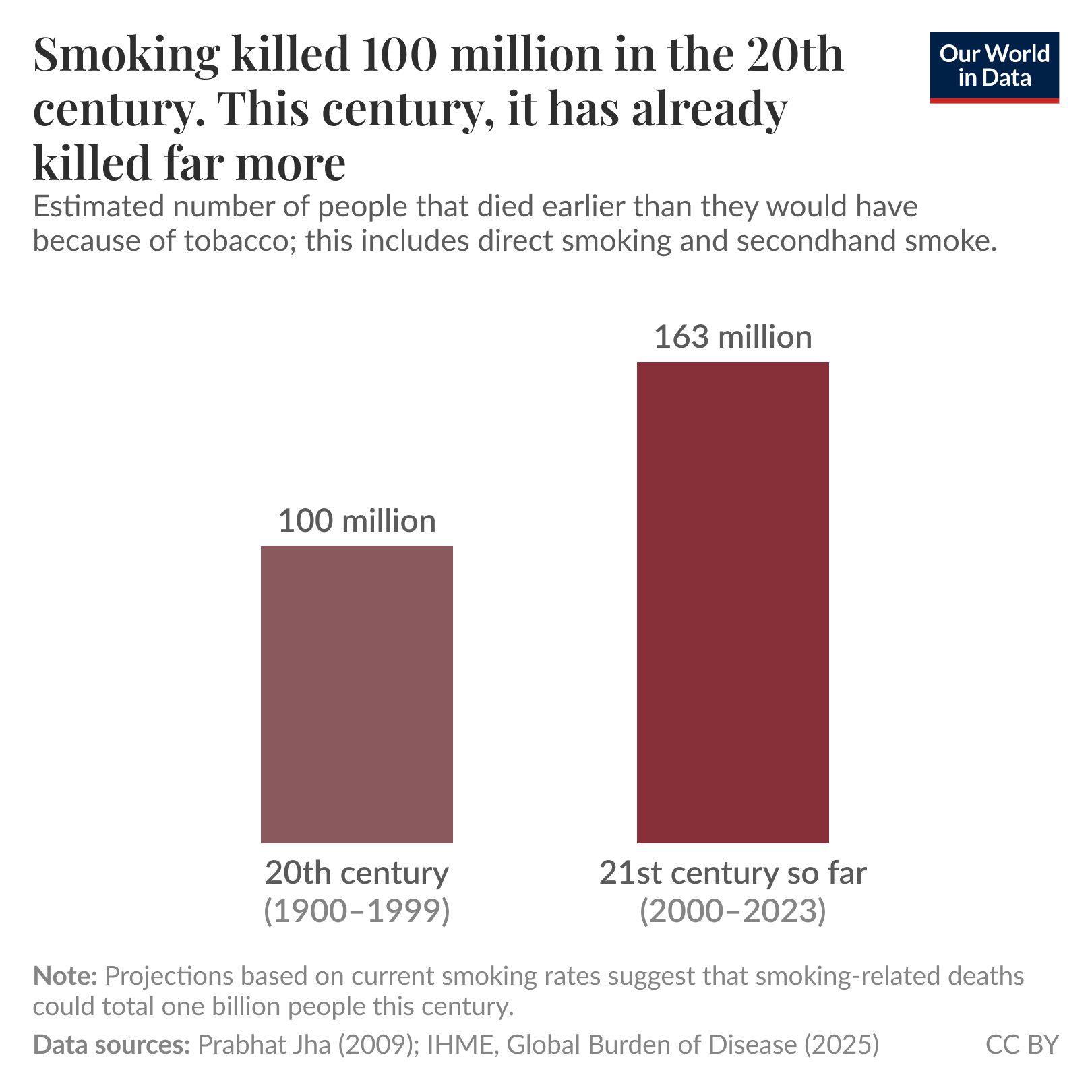
This is the story of an invention that claimed a hundred million lives in the 20th century, and — if we continue like this — will take a billion lives in the 21st century. It is the story of ‘the deadliest artifact in human history‘, which still kills 8 million peoplea year. It is the story of a greater killer than malaria and tuberculosis, car crashes and climate change, war and disasters combined.
I am talking, of course, about the cigarette. Or perhaps I should say: the tobacco industry.
To give you an idea of the scale of the devastation — imagine reading the following news item: ‘Jumbo Jet crashes on runway, no survivors’. And imagine that half an hour later the same news item appears — ‘Another Boeing 747 crashes, again no survivors’ — and thirty minutes later again. Then assume that this continues all day and night, and that eventually more than fifty planes crash in 24 hours. Finally, imagine that it goes on like this all year long.
That’s how many deaths the tobacco industry causes.
And yes, it’s a fabulously lucrative business. To put some numbers on it: a modern cigarette machine produces 20,000 cigarettes per minute; 10 million per eight-hour shift. According to epidemiologists, there is one death per million cigarettes, and so we are talking about 10 deaths per shift. The companies make about a penny per cigarette, which means each tobacco death is worth $10,000 to the industry. That’s $5 million per Jumbo Jet, every 30 minutes.
Now you may be thinking: this is old news, isn’t it? Surely smoking is on the wane?
If only it were. The global revenue of the industry is still rising. The number of smokers is declining slightly in rich countries, but that’s more than offset by the rise of vaping and the growing popularity of smoking in lower- and middle-income countries (where the tobacco industry has virtually free rein). Moreover, companies like Philip Morris are all too happy to dismiss smoking as ‘old news’ so they can continue down their old path.
The result is a kind of mass blindness. That which is insane — fifty crashed Jumbo Jets a day — has been normalized.
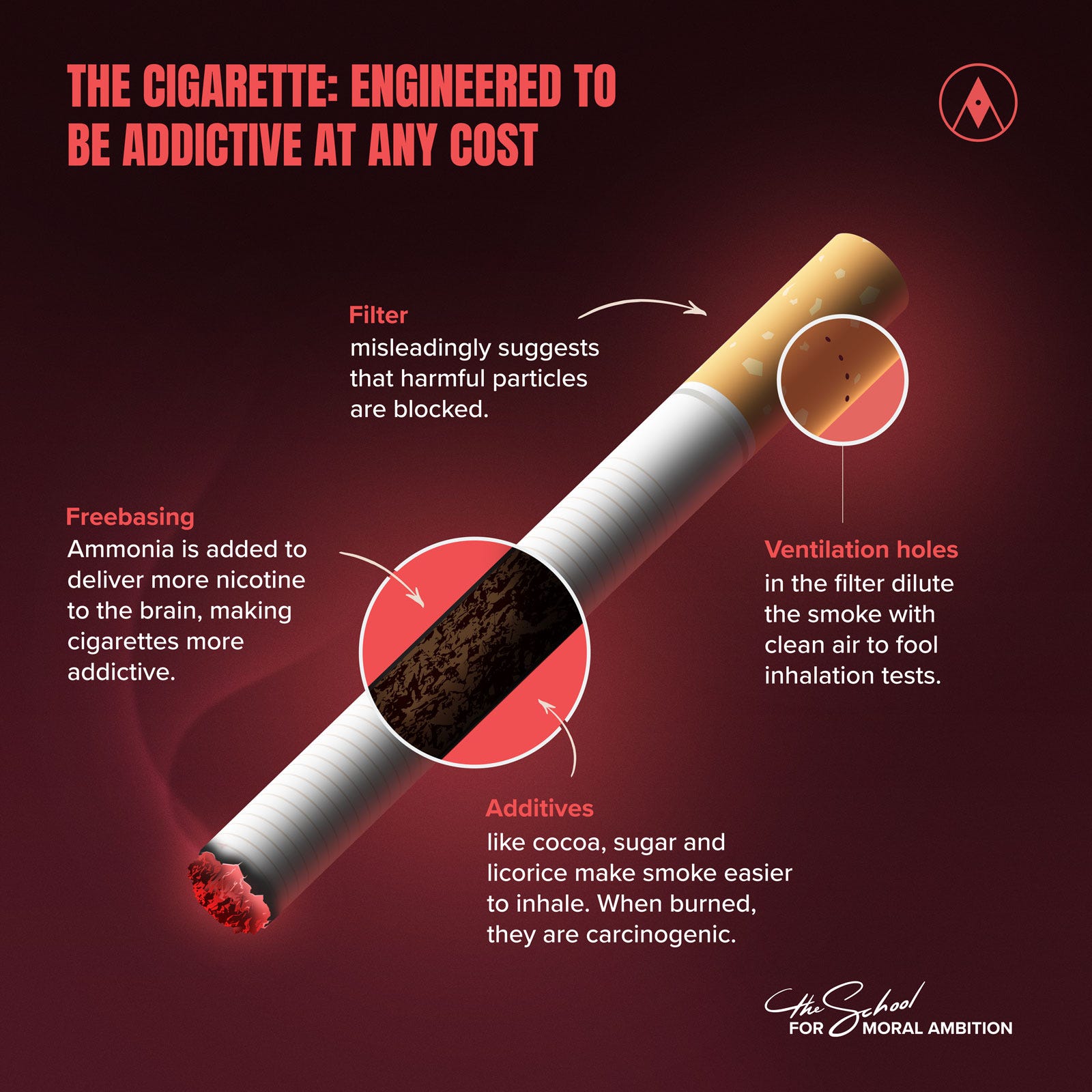
Interestingly enough, the cigarette is a fairly recent invention. Sure, people have always smoked, but the inhalable cigarette is a modern phenomenon. It is the result of decades of development, and a research budget of tens of billions. The cigarette of today consists of just two-thirds tobacco, to which literally hundreds of substances are added: moisturizers, impact boosters, cough suppressants, flavorings, you name it. All to make the product as addictive as possible.
To market this invention, the tobacco industry launched one of the largest propaganda campaigns in human history. Around 1960, nearly half of all American television shows were ‘brought to you by’ the tobacco industry. In the early 1990s, a study of toddlers found that the name and face recognition of Joe Camel was as strong as the name and face recognition of Mickey Mouse.
And then there’s everything the tobacco industry has done to cast doubt on the lethality of cigarettes. By the early 1950s, a scientific consensus had emerged that smoking causes cancer, and the industry decided to take action. The conspiracy began on Dec. 14, 1953, with a meeting of the CEOs of the major tobacco companies at the Plaza Hotel in Manhattan, New York. There it was decided to engage the lobbying firm Hill & Knowlton to put up a giant smoke screen.
For decades the industry kept saying that ‘more research’ was needed, when in fact their own researchers knew better. Doubt is our product, was the mantra of the industry, just as fossil fuel energy companies spent years casting doubt on the reality of climate change. Millions were spent on ‘tobacco research’ that was in reality about other things (’decoy research’ as historians call it).
The campaign was an overwhelming success. It took until the 1980s for most people to realize that smoking is not just a little harmful, but one of the deadliest habits you can get into. Up to two-thirds of all smokers die from smoking. Yet as recently as 1994, the seven CEOs of the major tobacco companies (‘the Seven Dwarfs’) testified under oaththat nicotine is not addictive.
Meanwhile, the industry launched a series of ‘innovations’ that would supposedly make the cigarette ‘safer’. But all these gimmicks — filters, ventilation, ‘light’ cigarettes — were scams. Internal Philip Morris documents show that the company considered ‘selective filtration’ a ‘thermodynamic impossibility’ as early as the 1950s. A cigarette filter is similar to drinking beer through a thinner straw — you may have to suck a little harder, but you really don’t get less in.
Cigarette ventilation is also hogwash. According to measurements of some smoke machines, ‘ventilated’ cigarettes with small holes in the filter may appear less toxic, but the industry knows that smokers pinch those holes shut. It’s like poking a few holes in a straw, putting your mouth over those holes and then claiming you’re ingesting less alcohol.
The tobacco industry’s latest hoax is the e-cigarette (vaping), which is said to be less harmful than the regular cigarette. Yet independent research shows that many vapes contain more toxic and addictive nicotine than an entire pack of cigarettes, and that vaping youngsters are three times more likely to start smoking. In the last decade, teen vaping has exploded across Europe. A leading British health expert recently warnedthat, if the rise of vaping maintains this trajectory, almost all children will vape within five years.
And then, finally, we have the biggest myth of all: the fiction that cigarette smoking is a free choice. In reality, most smokers start when they are minors, and about 70 percent want to quit. Every year more than half attempt to do so, but because the cigarette has been made so addictive, that attempt is often in vain. A Canadian studyfinds that on average 30 (!) quit attempts are needed to finally break the addiction.
The tobacco industry knows full well that nicotine use rewires your brain and creates a pharmacological dependence as strong as the addiction to heroin or cocaine. That makes nicotine totally different from alcohol, because only 3 percent of alcohol users are alcoholics. For cigarettes, it’s 80 to 90 percent. People who are happy to smoke are so rare that the industry has a name for them: the ‘enjoyers’. Young people also have their own names in the industry’s internal documents: these are the ‘learners’, ‘pre-smokers’ or ‘replacement smokers’.
Someday historians will look back on our time, and find it incredible that the tobacco industry was able to run its course for so long. That a product containing arsenic, cyanide and radioactive isotopes could be legally sold in supermarkets. That so many people continued to underestimate the danger for so long — because how many people know that smoking also causes hundreds of thousands of miscarriages, and ailments like blindness, baldness, cataracts, early menopause and erectile dysfunction?
The historians of the future will marvel at the countless chemists who did everything they could to make smoking as addictive as possible. About the countless marketers who did everything they could to make smoking as sexy as possible. About the countless lawyers who did everything they could to cover up the lies of the tobacco industry. ‘I have studied these companies for decades,’ writes the eminent historian Robert N. Proctor, ‘and still have to rub my eyes from time to time, marveling at some new revelation of malfeasance or chicanery.’
This industry is all too eager for us to believe that the battle against Big Tobacco has been fought. That smoke-free spaces, warning labels, the ban on advertising and hefty taxes have done enough to curtail the problem. But nothing could be further from the truth. There is still a long, long way to go.
The ban on advertising has increased manufacturers’ profit margins. The industry knows that educating young people can make smoking even more popular. And tobacco taxes have been dubbed ‘the second addiction’, not of the smoker, but of the government, which makes so much money from smokers that it doesn’t want to make life too difficult for the industry. (In 2023, New Zealand scrapped its smoking ban to pay for tax cuts.)
Still, this deadly industry can and will one day come to an end. For that to occur, a number of things must happen. First, we need to get angry again. Without public outrage, there is no political pressure to hold these companies to account. Second, many more people — activists and lobbyists, lawyers and doctors — must join the fight against the tobacco industry. Third, we must be crystal clear about our end goal: the manufacture and sale of cigarettes must eventually be banned.
Yes, people have always smoked. Anyone ought to be free to plant some tobacco in their garden for their own use. But no one should be allowed to poison others on an industrial scale. The cigarette is a fraudulent product that, like asbestos and lead in paint and gasoline, should not be produced and sold.
If you’d like to watch a 2-minute version of this essay, here’s a snippet of an insanely powerful speech one of our fellows, Jeltsje Boersma, gave at our last Fellowship Summit in March 2026: