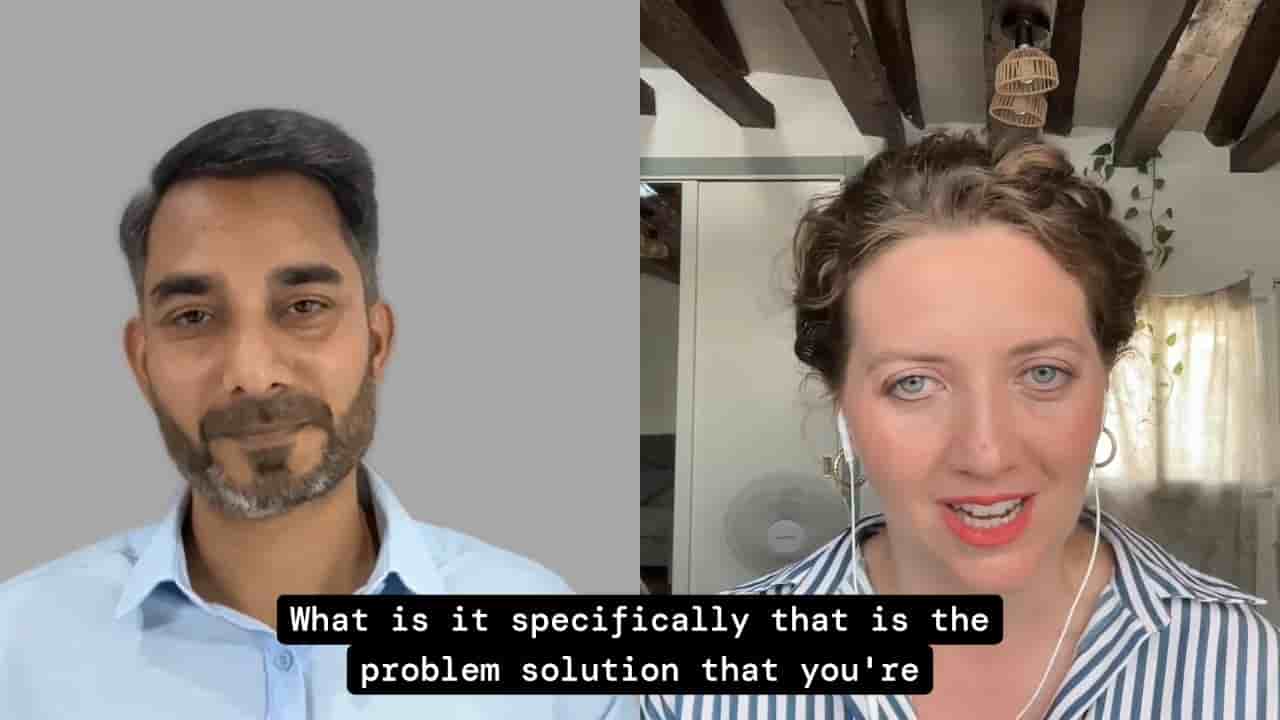
Episode 8, Abhay (IP Author) sits down with Saskia van Ryneveld to unpack a question every patent professional is quietly asking: general purpose LLMs claim to be "good at everything", so why do they still fall short when you point them at a real patent specification?
Patent drafting is an engineering problem disguised as legal writing. That's the core conviction Abhay Porwal, VP of Product Strategy Development at IP Author, has carried across three distinct careers: mechanical engineer, patent agent, and now AI product builder. The thread connecting all three, he argues, is the same discipline — solving an optimization problem under constraints.
The insight sounds counterintuitive until he explains it. A patent claim is not a sentence written to communicate. It's a boundary drawn to protect. Every word carries deterministic weight. Use a term once and you're committed to it everywhere. Change a hyphen and you may have, in the eyes of a patent examiner, introduced a different concept. "Engineering the language" is how Porwal describes the task — and it maps directly onto how he was already thinking as an engineer looking for optimized solutions within constraints.
A patent document is not a set of sentences put together. It's a narration that you are saying. Every paragraph has a meaning, it has a weight associated.
The boundary metaphor runs through everything he does. Claims drawn too broadly get rejected. Claims drawn too narrowly get walked around by competitors. The attorney's job is to find the optimal boundary given what the inventor knows today, while leaving room for how the invention might apply tomorrow. Inventors, Porwal notes, tend to see their solution in its current, specific form. A good patent professional with engineering fluency can see the broader landscape and expand the claim accordingly — without inventing anything new themselves.
When large language models arrived at scale in late 2022, Porwal's reaction was characteristic: excited and immediately analytical about the limits. The capabilities were real. LLMs are genuinely good at brainstorming, drafting, summarizing dense documents, and keeping a professional current across jurisdictions and examination frameworks. For a patent agent who once had to manually read everything to stay current, having a research assistant that has "read everything" and can surface what's relevant is a meaningful time return.
But the confidence the models project creates a specific trap for legal work. LLMs produce documents that look professionally polished and signal they're ready to ship — when they contain fabricated citations, hallucinated positions, or interchangeable terminology that would be read as inconsistent in a patent context. Porwal describes this bluntly: the model wants to be the top student, is always happy with its work, and has no self-critical doubt built in.
LLMs have raised the quality floor. Not the quality bar — the floor.
That framing matters. General models can reliably get you to a "good enough" provisional application under deadline pressure. They cannot reliably get you to a final, fileable document without human review. And they cannot, on their own, maintain coherence across a drafting process that spans ten versions, multiple attorneys, and eighteen months of prosecution.
The consistency problem is structural, not just a current limitation. Context windows are small. A conversation that starts with a well-defined claim set drifts, and by the seventh round of prompting you may find yourself back at the starting point having spent two hours in a circle. More critically, if two attorneys work on different sections of the same application using a general model, the sections may not read like they describe the same invention.
The natural response to these limitations is to build domain-specific tools on top of the foundational models. Porwal is careful to distinguish between a vertical tool that adds durable value and one that's merely a wrapper — a prettier interface around a general model that will become redundant as the underlying model improves.
"Vertical tools are nothing without foundational models." But the domain layer — the rules, the codification, the enforcement — that stays with the tool regardless of how good the engine gets.
The domain layer is the actual product. For IP Author, that means encoding patent-specific workflows: the micro-steps an experienced attorney follows from invention disclosure through prosecution, the jurisdiction-specific rules, the terminology consistency requirements, the guardrails that prevent the model from doing the one thing a general LLM will always want to do — invent something better.
That last point is not a small thing. A general LLM, given an invention disclosure, will naturally try to improve the solution. It's helpful by design. In patent work, that's disqualifying. The attorney's role is not to invent; it's to protect what the inventor has disclosed. A tool that starts suggesting technical improvements has stepped outside its lane and created authorship questions that nobody wants to litigate.
The guardrails enforce this. The model is, in Porwal's phrase, "made dumb that way" — constrained to work only with what's in the disclosure, to flag novelty without fabricating it, and to maintain consistent terminology across every section of the document.
When foundational models improve, a well-built vertical tool improves with them. The engine gets better; the domain layer gets more precise results from it. Porwal frames this as the sustainability test for any vertical product: if the value you add disappears when the underlying model gets smarter, you never had durable value. If your domain layer encodes rules and experience that the foundational model doesn't have and can't infer, you compound rather than compete.
The practical workflow starts well before any drafting. An inventor submits a disclosure. The attorney needs to understand the invention, locate prior art, identify genuine novelty, and appreciate what the examiner is likely to challenge. This stage alone carries enormous cognitive load, and it's where AI tools deliver their most unambiguous time return: swiftly reading through large PDF sets, summarizing prior art, and generating a structured comparison against the disclosure.
From there, the tool moves into claim drafting and specification building. Two modes are available: autopilot, where sections are generated end-to-end and the attorney reviews the full output, or steering mode, where the attorney reviews each section as it's produced and provides directional input before the next section begins. Steering mode keeps the human in the loop at every stage and prevents the end-of-session surprise where the document has drifted from what was intended.
The prosecution stage is where Porwal sees the largest labor displacement. An office action arrives twelve to eighteen months after filing. The attorney now needs to re-read their own invention, download and read three to seven prior art references cited by the examiner, parse a verbose examination report, and construct a response that is simultaneously a legal argument and a negotiation over claim scope. Every one of those steps is friction. The tool takes an application number, pulls everything automatically, determines whether the examiner has even correctly understood the invention (sometimes they haven't), and generates multiple response strategies at different levels of aggressiveness. The attorney chooses, nudges, or discards and provides their own approach. The tool drafts accordingly.
So human in the loop, not human only, not no human — human in the loop is going to be the future of the industry.
The question underneath all of this is whether AI replaces attorneys. Porwal's answer is direct: not now, not in any foreseeable future. What changes is the ratio of execution to judgment in an attorney's day.
The repetitive execution work — the reading, the searching, the formatting, the version management, the cross-referencing — that goes to the tool. The judgment work — strategy, argumentation, interpretation, client communication — comes back to the attorney with more time and clearer inputs than before. The attorneys who will struggle are those who delegate to the tool and stop reviewing, and those who refuse to engage with the tools at all. The ones who will thrive treat the tool as a bright junior associate: you give it the task, you review the deliverable, you sign off on what goes out.
The accountability loop never transfers. That's the point Porwal returns to consistently. The tool can raise the quality floor, maintain consistency, eliminate micro-step friction, and surface strategies you might not have considered. It cannot bear professional responsibility for what gets filed.
His final piece of advice for anyone starting with these tools: don't treat it as a vending machine. A single prompt is not a transaction. The useful output tends to arrive at the fifth or seventh or tenth response, after enough back-and-forth that the tool has your context and you've had enough pushback to sharpen your own thinking. The conversation is the product.