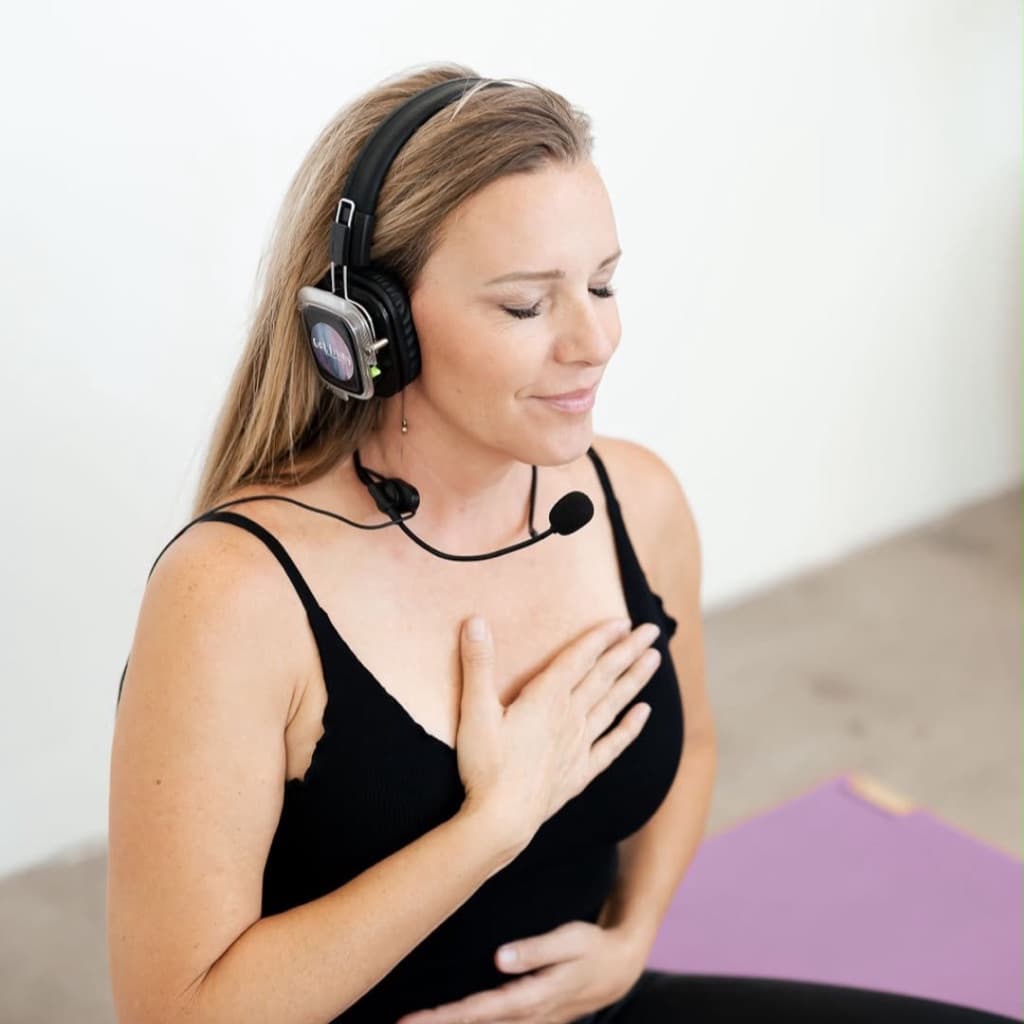
Aleca Chambers survived a suicide attempt, two decades of people-pleasing, and a marriage built on alcohol. Breathwork gave her the clarity to stop pushing everything down.
Aleca Chambers was a people-pleaser before she knew what that word meant. From childhood she took on the emotional weight of everyone around her, keeping the peace, staying quiet, pushing her own feelings down so far that she eventually forgot they were there. By the time her marriage fell apart, in a collapse that included betrayal from both her husband and a close friend, she had been carrying that weight for decades. She became suicidal. She survived. And then, slowly, she started breathing.
That's the arc Aleca shared in our first interview together, and I want her story to reach people who are exactly where she was. Because the way she tells it, she makes it sound almost ordinary. Like, oh, that just happened to me, and here's the new thing I found. But there is nothing ordinary about what she's walked through.
Aleca describes her baseline before breathwork as pure survival mode, and she doesn't mean that casually. She was a meth addict in her earlier years, sober now for over twenty years. She moved with her husband to break free from drugs, and that worked, but then life behind closed doors kept producing new coping mechanisms. He became an alcoholic. Alcohol became the one thing they had in common.
"Our whole relationship was giving some alcohol and I wanted more. I wanted something different and there was no change."
She became the designated driver, the peacekeeper, the one who held everything together for her three kids while her own needs went unspoken. She doesn't carry resentment about that now. She genuinely means it when she says she sees they were on completely different paths, that it wasn't his time to change. But the cost of staying in that dynamic for so long was everything she had left of herself.
When betrayal finally broke the marriage apart, the darkness that followed wasn't just heartbreak. It was the accumulated weight of a lifetime of self-erasure, and it became too heavy to hold. She attempted suicide. Survived. And felt something shift.
Aleca is clear that surviving wasn't a resolution. It was a starting line. The suicide attempt, she says, was rooted in fear, specifically the fear of losing the life she had constructed, the facade of a marriage, the sense of identity built around other people's needs. Surviving it forced a reckoning with a question she had never seriously asked herself: what did she actually want?
I love every day, every heartache, every downfall, every obstacle, every challenge, because I can get through hard things.
After the attempt she started looking for something. She found breathwork, crystals, spirituality, not as substitutes for therapy but as tools for turning inward. Things she had always been drawn to but had pushed aside because there was always someone else's needs to attend to first.
The first session Aleca came to was a holotropic inner child session. She didn't know what to expect. She was tense for a while, she says, and it took some time before she could relax into it. But in the days after, she noticed something: she had a little more clarity. Her communication with her kids shifted. Her mind felt less locked.
Every session has been different, and that's the evidence of growth.
She kept coming back. And over nearly three years, the sessions have cracked open things she had been sitting on for decades. She cries in some. In others she laughs. Some bring up visions, trees, butterflies, small peaceful images that she then spends time trying to understand. She's not a naturally visual person, so when something appears in a session, she takes it seriously.
What matters most to her isn't the in-session experience itself. It's the integration, the days afterward when a memory will surface, a feeling will come up, and she'll recognize it as connected to what she processed on the mat. That's when the perspective actually changes.
"In integration is when it really works, and when you pay attention."
She's also learned to work with her own breath during sessions. When the intensity gets overwhelming and her mind starts telling her she can't handle it, she's learned to slow the breath down, let the fear surface, acknowledge it, and then pick the pace back up. That moment of control, she says, is when the mind shows you what's actually holding you back.
One of the things Aleca wanted to make sure we talked about was grief. Not just the grief of losing a person, but the grief of losing a self. She describes grieving the little girl she was, the marriage she thought she had, the identity she built around keeping other people okay. Grief, she says, is not reasonable. It shows up for the dog you lost, the father who is gone, the version of yourself you left behind. All of it counts.
"Grief is something that comes up all the time, because you're losing parts of everything that you thought were you."
Breathwork hasn't eliminated that grief. But it's given her a place to feel it without having to hold it together for anyone else. In a session she can cry and simultaneously hold herself. She can give herself the comfort she spent decades giving out. That reframing, taking the strength she always directed outward and turning it inward, is what she keeps coming back to.
Aleca recently finished a bachelor's degree in psychology. She has a life coaching certificate. She's working through the hours to complete her breathwork facilitator training. She's thinking about nursing school because the signs, the nudges as she calls them, keep pointing that way. She doesn't know exactly what comes next, and she says that's fine.
What she does know is that she can see the nudges now. Before breathwork, she was too blinded, too defended, to notice them. Now she catches them and follows where they lead, not anxiously, but with a kind of open curiosity she says she didn't used to have access to.
Her relationship with her kids has changed. They tell her they're proud of her. She tells them things now, expresses feelings she used to suppress, uses her voice in ways she never did before. She's also let people go, not out of anger but out of clarity. The ones who weren't there during her hardest moments, who she was always there for, she's stopped carrying that imbalance.
She can look in the mirror and tell herself she loves herself. She takes selfies now, something she rarely did before. Her face, she says, has slimmed out. She smiles more in photos. These sound like small things. They're not small things.
If you're somewhere she used to be, that dark and locked-down place where keeping the peace feels like the only option and your own needs feel like a luxury you can't afford, she wants you to know: it doesn't have to end there. There is more. Finding it just requires turning toward yourself, even for five minutes, even just to breathe.