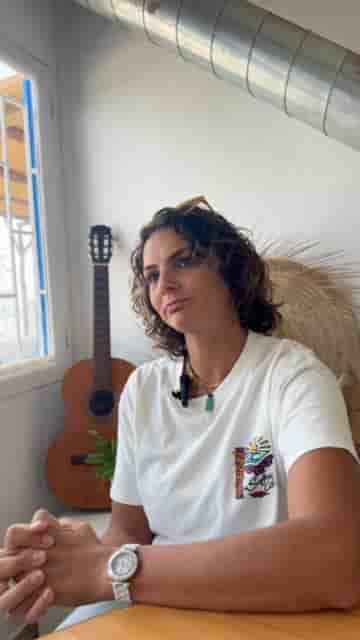
Sukeina traded a multinational career and a nutrition business for surf coaching and a converted van. Life runs wave after wave, not in a straight line.
Sukeina is 36, a mother of two, and the first thing she'll tell you about herself is that she surfs. Not as a hobby. Not as a weekend escape. As an identity, the one that reorganized everything else.
Getting there took dismantling a very specific script. You study hard, you pass the baccalaureate with a good grade, you go to a grande école or a prépa, you become a doctor, an architect, an engineer, a professor. You secure your life. That was the expectation, and for a long time she followed it: a scientific degree, then an engineering degree, then years in a multinational working eight to seven, plus a parallel business in nutrition that performed extremely well by every external measure. The problem was simple: she wasn't eating any of it.
"Even if I was doing money with it, even if I was financially well, in my head it wasn't going to."
Covid arrived when she was 29, about to turn 30. She did the math. Tomorrow is 40, then 50, and it moves faster than you think. She stopped, took the recul she hadn't had time for while managing parents, children, schedules, and everything else pulling at her attention, and asked herself what she actually wanted to do.
Sukeina grew up in a household where the beach was off-limits. Her mother's logic was the common one: the ocean is dangerous, synonymous with drowning, not a place for the family. So they didn't go.
At 21, she saw a girl six years younger than her surfing, doing it easily, making it look entirely possible. She signed up for a surf course at the only club in the region, booked six sessions, and only ever needed the first one.
Once I started surfing, it was my mind. I didn't want to stop.
That first day is still one of the most significant of her life, not just personally but for what it unlocked in her family. Her mother's fear of the ocean dissolved. The relationship her children now have with the water traces back to that shift. She surfed while pregnant. She brought her kids to the beach as early as she possibly could. The ocean became a shared language in the household instead of a boundary.
Ask Sukeina what surfing taught her and she'll describe it in precise terms. To reach the peak, where you position yourself to catch a wave, you first have to paddle through the breaking water. That path has obstacles. You get there, you read the horizon, you watch the sets coming in, and you anticipate. Then a wave arrives. It might look right and not be right.
You can let a wave pass. The next one is already coming.
Applied to everything outside the water, this is how she thinks about career pivots, about a job interview that went well on paper but didn't produce an offer, about the two years of groundwork before her current project became real. The obstacles on the way to the peak are not failures. They're the passage.
For two years she worked toward something she calls WOW, an acronym and also a literal feeling she wants people to have. Wave after wave, wave upon wave, as in: life and growth move in sets, not in a single clean line.
The concept is a surf club built to welcome people of every background, nationality, age, and means. Children of four, adults of 56 surfing alongside their 17-year-olds. People who arrived not knowing how to swim and learned through the motivation surf gave them. The point isn't the sport in isolation. It's the community, the shared codes, the direct effect on how you feel physically and mentally, how you show up for your family.
"Not just the surf, the mode of life, the influence that the surf can have on the person, on his morale, on his physique, on how we are in the health of our family, children, to this life."
Morocco had no surf van culture when she bought a second-hand van and converted it. She had seen it in Spain and Portugal. She wanted to keep surfing the way she wanted to surf, without stopping to carry ten bags, parasols, jewelry, and changes of clothes across the sand every time. So she built the solution instead of waiting for someone else to offer it. She kept her small car. She skipped the beautiful car. She rearranged priorities around what made the life actually work.
One of the clearest things she says: stop spending money on madahir, on appearances, on the performance of a life rather than the living of it. The standards on social media point toward the house with the garden, the pool, the new car, the hotel. Whether any of that fits your actual life is a different question entirely.
Her version: vintage and second-hand clothes, sandwiches on the beach instead of restaurants, a barbecue with everyone, ten full days at the beach in the year. The economy on that is real. The happiness is also real. The calculation isn't about refusing comfort. It's about refusing the performance of comfort on other people's terms when your own terms are cheaper and more satisfying.
Stop wanting to please others. Start with what pleases you, and build from your own means.
She is careful to say she is not finished. The project is not complete. She has not arrived. What she has done is made a significant number of mistakes on the way to where she currently stands, and she's explicit that those mistakes are part of the record, not something to hide.
Sharing the process openly on social channels brought her things she didn't expect: prayers, messages, encouragement, hands extended from people in France and elsewhere who couldn't be present physically but found ways to help. Talking about it opened doors. Administrative support, institutional connections, and a wider horizon of possibility came from the willingness to say, out loud, that the path was not straight.
Life is not linear for anyone. When you see someone succeeding, the move is to learn from them, not to compete against them. The echelon where comparison lives is the wrong floor. Find a way to get where you want to go without benchmarking yourself against someone else's route.
"Trouve un moyen d'arriver là où tu veux arriver sans te comparer."
That's the operating principle: have faith, follow the current, get up when you hit the ground, and keep moving toward where you want to be. The next wave is already on the horizon.